Reviews: Medusa, Síofra, The Outsiders, Luzia and 10 Days in a Madhouse
Before the Toronto Fringe takes over the city, here’s a roundup of recent openings

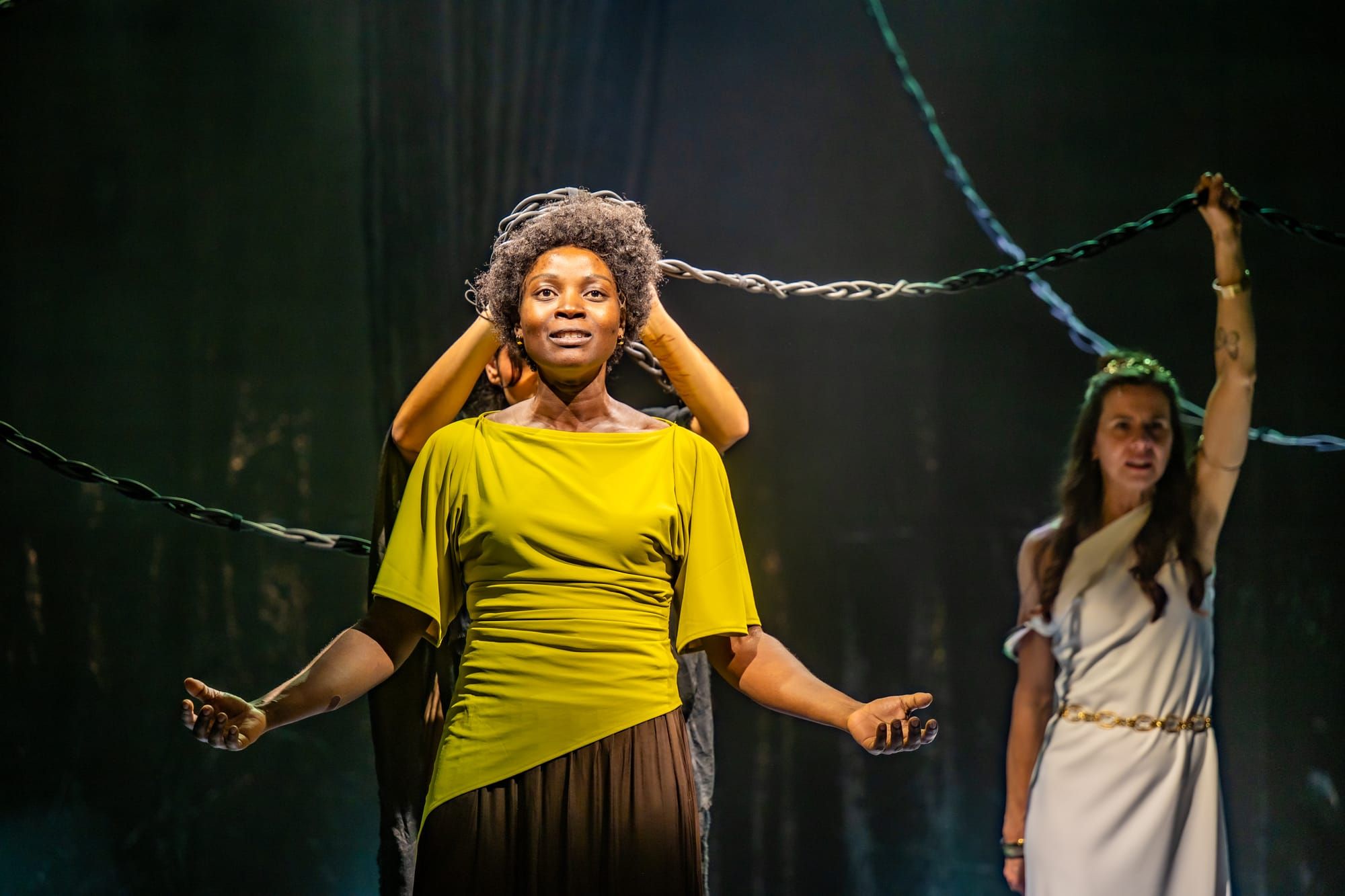
There’s a monologue in the middle of the second act of Erin Shields’ ambitious new play Medusa (Rating: ✭✭) that is as well-written and powerful as anything I’ve seen on a local stage this year.
In it, Michelle Monteith plays a woman who has taken the title character’s advice and gently but firmly told her handsy, overly familiar boss his attentions were not appreciated.
In maybe five minutes, we get a complete sense of the fallout from the confrontation; nothing overt happens, but her co-workers subtly disengage from her, failing to include her in committees or after-work drinks — that sort of thing. She feels a chill.
The unfairness and the unspoken conspiracy of silence will make you seethe with anger — an emotion that seems to have fuelled the play as a whole. In one scene, we feel for this character we didn’t know before. No technical tricks; no “immersion”; no in-joke about Greek myths — just superb drama.
It’s a shame that that sort of attention to detail isn’t present in most of the rest of the two-and-a-half hour show, which suffers from being both over-written and baffling.
The first part shows promise. The bright, conscientious Medusa (Oyin Oladejo) applies for and gets a job with the goddess Athena (Monteith). The income will help support her sisters, Stheno (Amy Keating), a single mom, and Euryale (Sasha Khan), who seems to have mental health issues.
Medusa develops ideas about affordable housing and income inequity, and assumes the warrior goddess will back her up. What she doesn’t count on, however, is the continual interruptions by Poseidon (Gord Rand), with whom Athena has a complicated history (she beat him out in becoming the patron of Athens).
This first act shows Medusa finding her voice — and her anger — mostly through her frustrating encounters with the existing patriarchy. It’s not just Poseidon who pulls focus from her goal, but also the effects of an unseen Zeus. Plus, Athena isn’t mentoring her the way she thought she would; she’s more concerned with climbing the ladder of succession in Mount Olympus.
Shields peppers the act with in-jokes that will make classics majors smile — there are allusions to Jason (Danté Prince) and Arachne, among others — but might feel disorienting to a general audience member.
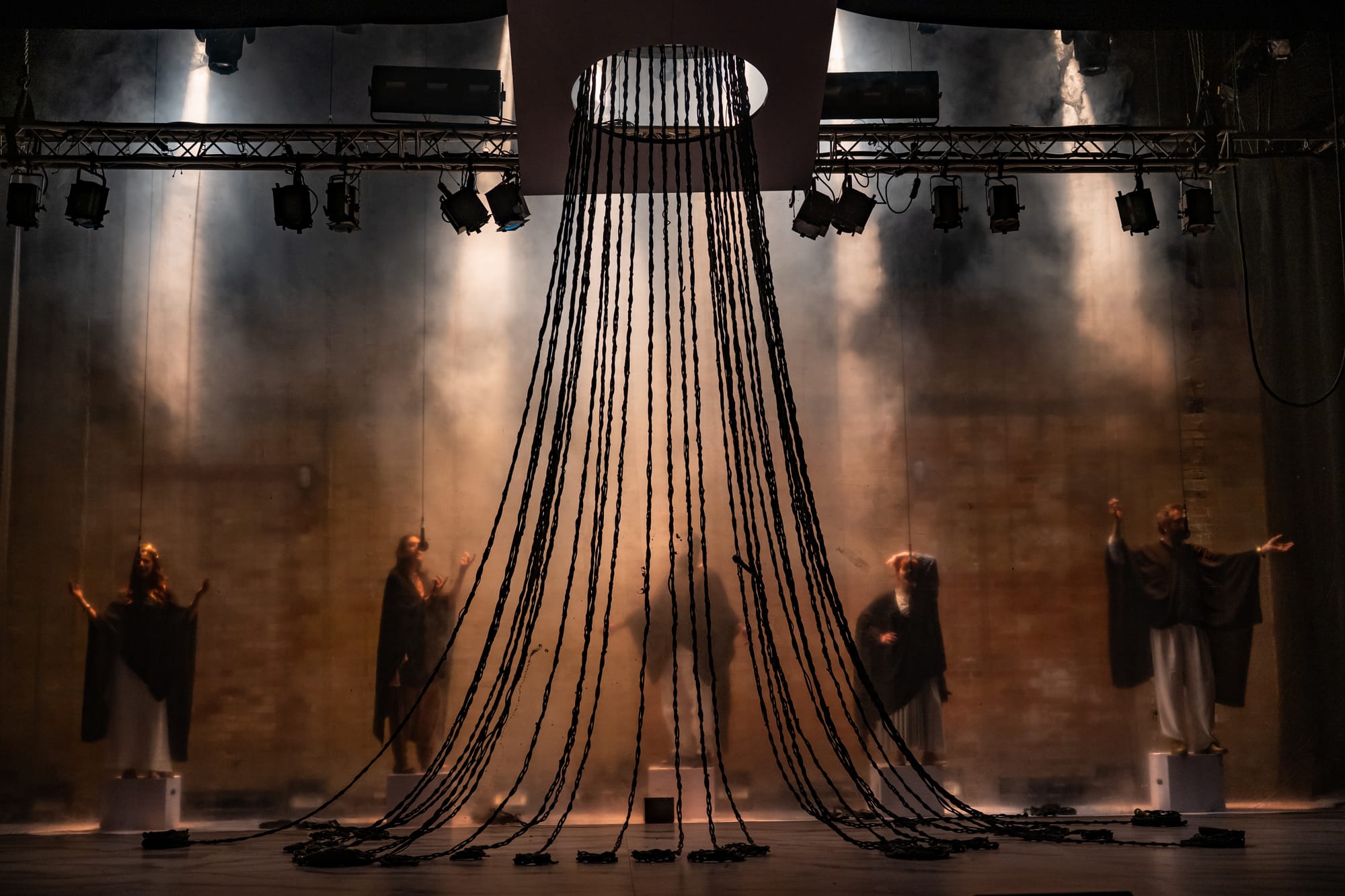
What’s even more distracting, however, is the gimmick that involves wearing headphones so we hear Medusa’s stream-of-consciousness thoughts, the Ss in the words often hissed, suggesting the snakes that will eventually make their way onto her head (this assumes we know the bare outlines of the Medusa story).
While at first these utterances — whispered into microphones by the ensemble — feel clever, they soon become repetitive. If the main narrative were clearer, perhaps this addition — billed as “immersive” by Soulpepper, in “collaboration with” Outside the March — would add a fascinating layer to the story and character, suggesting her growing disssssatissssfaction with her life.
The second act is set in a modern-day “rage room” called the Gorgon’s Cave, where people — mostly women — pay to act out their anger by trashing rooms. The titular Gorgon, Medusa, exists mostly as an audio presence, monitoring the goings-on from on high.
Annie (Keating) has worked there for several years; Percy (Prince) has just been hired. Their job is to help set up the scenarios for the Cave’s clients, and then, after the trashing has taken place, to clean up the mess.
The backdrops for some of the rages (which we see through a semi-transparent curtain) include a frat house and a worn-leather-style man cave. There’s a disturbing, powerful idea here about how women can only — are only allowed to? — unleash their anger through simulations like this.
For regular theatregoers, Keating’s Annie might bring to mind an earlier Outside the March show, Annie Baker’s The Flick, which was also directed by this play’s director, Mitchell Cushman. Some of Annie’s casual conversations with Percy have the same naturalism and subtlety from that other play.
But Shields has to keep the mechanics of her contrived plot going, especially once Percy (if you want to know what his name is short for, think of a certain Rick Riordan series) finds a silver platter, sword and winged runners.
If this had been a workshop production, it would have been full of promise and stylistic innovation. The actors, particularly Keating, Rand and Monteith, do the best with the material they’ve been given, and the designers (sets by Anahita Dehbonehie, costumes by Ming Wong, lighting by Nick Blais and sound by Heidi Wai-Yee Chen) do effective work.
But this production feels cobbled together with not much consensus over what it’s about. Shields/Cushman dispense with the headphones for the clearer, more intriguing second act. If they had been there, mine would have been angrily whispering, “What a wassste of thesssse peoplessss talentssss.”
Medusa continues at the Young Centre’s Baillie Theatre (50 Tank House Lane) until July 12. Ticket details here
Maddening material
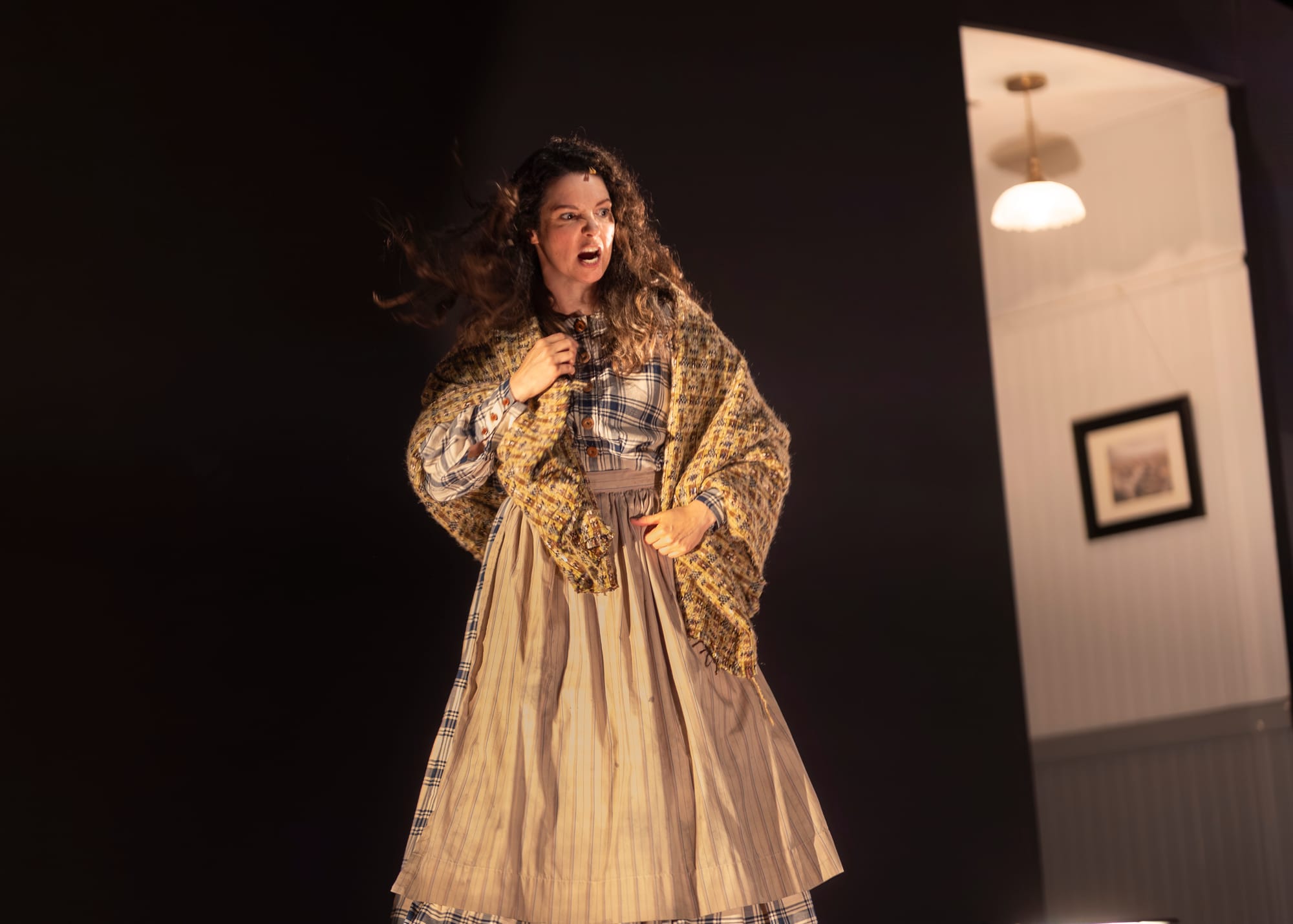
I was going to post my review of Rene Orth and Hannah Moscovitch’s powerful new opera 10 Days in a Madhouse (Rating: ✭✭✭✭) at the end because it already finished its short run (June 16 to 21) at Luminato, but it strikes me now that the piece has a lot in common with Medusa. (I saw the final performance.)
In particular, it shows how historically women’s lives have been controlled and manipulated by men. And it sheds light on serious flaws in the medical and mental health industries that persisted for decades. The whole situation evokes Medusa-like fury.
Nellie Bly (1864-1922) was a groundbreaking journalist who turned to undercover or stunt assignments because no one would hire a woman then for a news staff position. One of her most famous stories was about the treatment of women at New York’s Blackwell’s Island asylum in the 1880s. She feigned being mad and was admitted first to Bellevue and then Blackwell’s.
Once there, she saw — and experienced, first-hand — the horrific conditions the patients were living in. In meeting other inmates, she gleaned that many were committed for troubling reasons; some immigrant women were poor and spoke no English, while one woman was simply grieving the death of a child. No one was listened to, including Nellie, even when she explained that she was a writer.
Bly survived and wrote about it in a book that would help force the asylum — and the industry overall — to implement reforms.
Composer Orth and writer Moscovitch open their 70-minute opera by showing Bly at the end of her ten-day stay, when she’s stretched to her mental and physical limits, desperate to be let out. And then they move backwards in time.
The effect is a little disorienting, not unlike being in that asylum ourselves. But as the calendar turns back, it’s fascinating (and not a little disturbing) knowing in advance where all of the characters end up, particularly Lizzie (Taylor-Alexis DuPont), a mother grieving her infant. Motifs about getting on boats can be traced back to earlier (later) in the opera.
Musically, the piece is intriguing, too. Nellie (the marvellous Mireille Asselin) delivers a powerful aria near the end of her stay — which is really the beginning, when she’s been labelled “the Madwoman.” The music combines chamber orchestra instruments with electronic effects, resulting in an eerie, otherworldly mix of moods and tones.
At one point Orth uses a waltz played on a phonograph to potentially soothe the women, which provides a stark contrast with the setting they’re in (and perhaps nods to Milos Forman’s film adaptation of One Flew Over the Cuckoo’s Nest).
Under director Joanna Settle and music director Sandra Horst, there’s some terrific choral singing, including an amusing number in which the inmates purposefully sing off-key, suggesting the imbalance in their lives. The firm-voiced baritone Jorell Williams is resolute in his performance as the opera’s chief antagonist, Dr. Josiah Blackwell, whose motivations seem slightly sinister.
Mireille is highly effective as Nellie, but the structure makes her performance a difficult one to connect with emotionally (we’re also not shown the scene in which she’s released, but have an epilogue instead). This is an opera that could benefit from repeat watchings, so we can savour how the creators have put the work together.
DuPont’s Lizzie has a clearer arc, and the mezzo is staggering in the part, evoking her grief and illness with brutal force.
Horst conducts the orchestra — placed above the stage, as if surveilling the action — with sensitivity, while Faustin Linyekula’s choreography contributes to the momentum and pace of the opera.
Andrew Lieberman’s rounded set, evocatively lit by Bonnie Beecher, deserves special mention. It has edges you can’t see around and in the middle of it is a hallway from which you can occasionally see characters appear.
The effect, like the opera itself — a Tapestry Opera and Opera Philadelphia production and commission, co-presented by Luminato and the Canadian Opera Company, in association with TO Live — is unusual but highly memorable.
Síofra shivers
The Spindle Collective is emerging as a unique and imaginative indie theatre company. They describe themselves as a “female and non-binary-led horror-theatre collective weaving spine-tingling stories.”
Based on what I’ve seen of theirs, that’s an apt description. Back in January, I caught one night of their inaugural Toronto Horror Theatre Festival, which included their piece spilleHOLLE, about a German mother and her adolescent daughter (company co-founders Kathleen Welch and Natalia Bushnik, respectively) bound together by a mysterious spinning wheel/spindle.
I believe that piece, or an expanded version of it, will be the third part of their Dark Mother Trilogy, three plays that deal with fertility and motherhood through the folklore of three different countries. The first play, SAMCA, was inspired by Romanian folklore. Síofra (Rating: ✭✭✭), the second, is drawn from the folklore of Ireland, and it’s just finishing a run at the Red Sandcastle Theatre tonight.
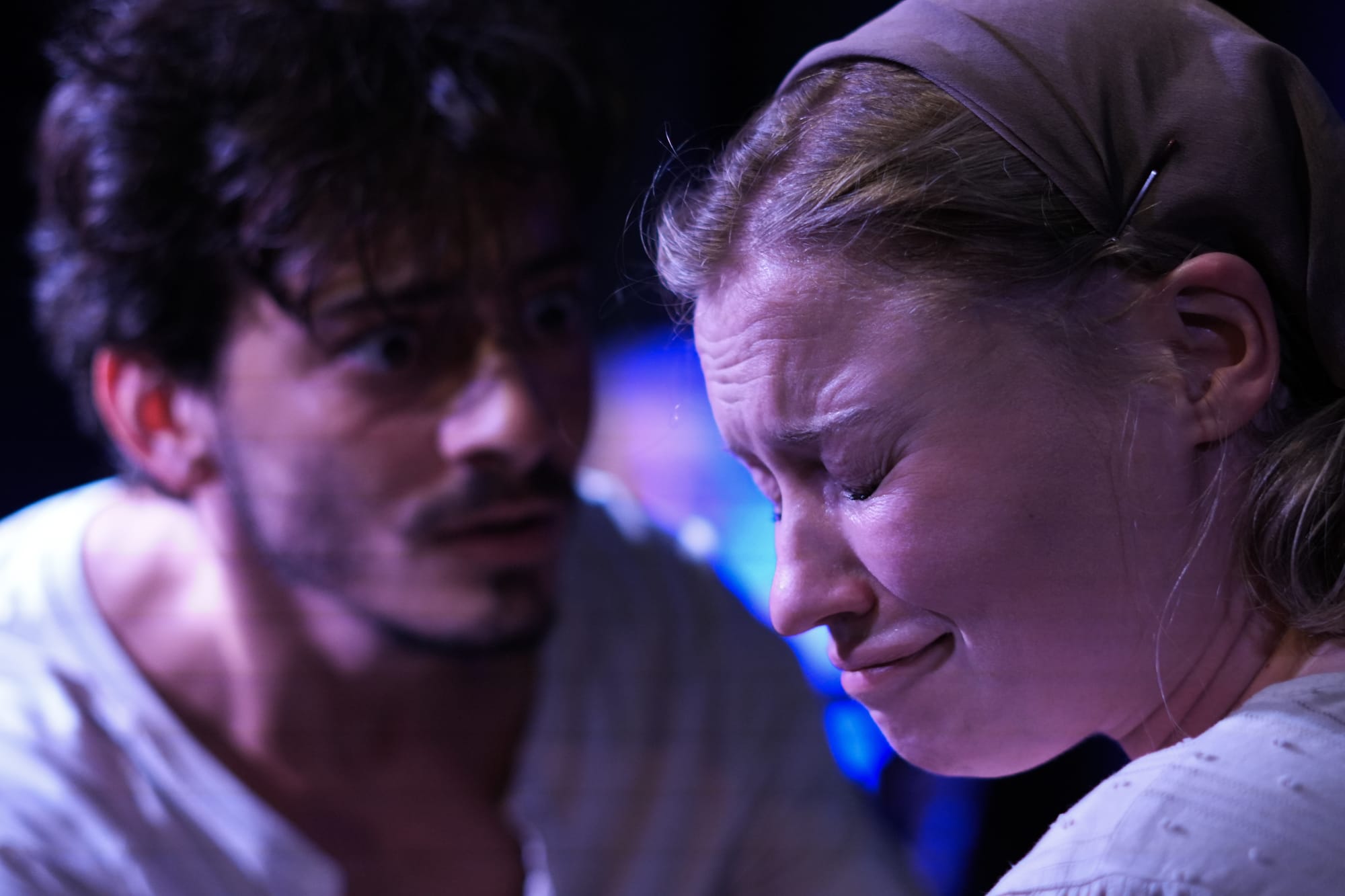
In 19th-century rural Ireland, newlyweds Mary (Bushnik) and Michael (Darius Rathe) build a home on a “fairy mound” under Knockma Hill near Galway. The land came cheaply, perhaps because of superstition around elves or fairies thought to steal human children and replace them with their own.
When Michael is called away to fight in an uprising, Mary is left alone with the baby and her ailing grandfather (Brian Taylor). She has problems falling asleep, and sometimes sleepwalks.
Co-writers Bushnik and Welch (who also directs) never spell out what exactly happens to Mary and her baby. Instead, we get a patchwork quilt of opinions and theories from Mary’s sister, Siobhan (Rachel Offer), her husband Thomas (Justin Otto), the local doctor (Eric Woolfe) as well as townsfolk played by Claire Haig-Halsall and Jeanie Calleja.
The result is highly atmospheric and chilling — especially in details like when Mary tells us the “shape” of the baby is wrong. Welch’s score also contributes to the heightened tension.
While the mystery of what happened to mother and child is intriguing, I’m not sure the structure does it any favours. Woolfe, artistic director of Eldritch Theatre (who are presenting the Spindle show with an “in association” credit) handles some narration from the strange, detached perspective of the doctor. And while Welch handles the many comings and goings of the actors gracefully, I wish I could see a more streamlined version of the plot; some of the details feel fussy, repetitive and unnecessary.
In addition, the performances are a little uneven; as played by Bushnik, Mary’s emotional and physical decline is palpable, but both Rathe and Otto seem to shout many of their lines, which is unnecessary in the tiny theatre. Offer adds sympathetic support as Siobhan, while Calleja’s seen-it-all neighbour seems to spit out her words in contempt.
Perhaps one day the Spindle Collective will present all three plays in their Dark Mother Trilogy in rep. These are narratives that have endured for centuries and crossed cultures. As many A24 films have shown, there’s definitely an appetite for this kind of elevated genre material, especially when it’s done so well.
Síofra continues at the Red Sandcastle Theatre (922 Queen East) until June 28. Ticket details here
Reviewed elsewhere
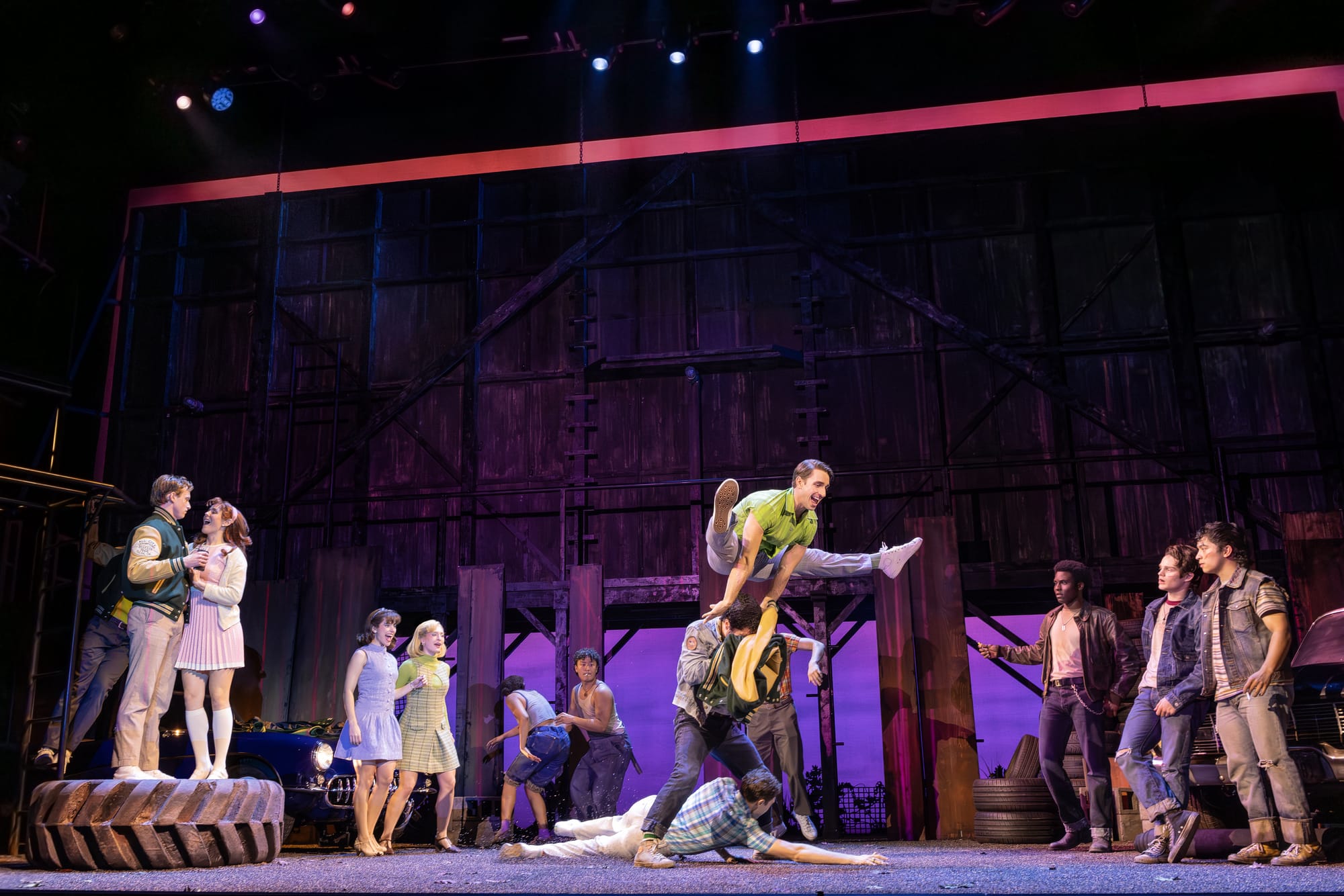
I didn’t love The Outsiders (Rating: ✭✭✭), which won the Tony Award for best musical in 2024 and arrives in its national tour as part of the Mirvish season.
Director Danya Taymor and Canadian-born choreographers Rick Kuperman and Jeff Kuperman certainly make the most of the material, S.E. Hinton’s beloved novel and Francis Ford Coppola’s much-less-beloved film adaptation.
But it feels a bit like Grease meets West Side Story, except with worse songs. None of the characters has much depth, there’s a faux lyricism that can read as pretentious, and the songs and book are pretty forgettable. Couple of good performances, though.
Here’s my review of the show, which runs at the Princess of Wales Theatre until July 26. Ticket details here.
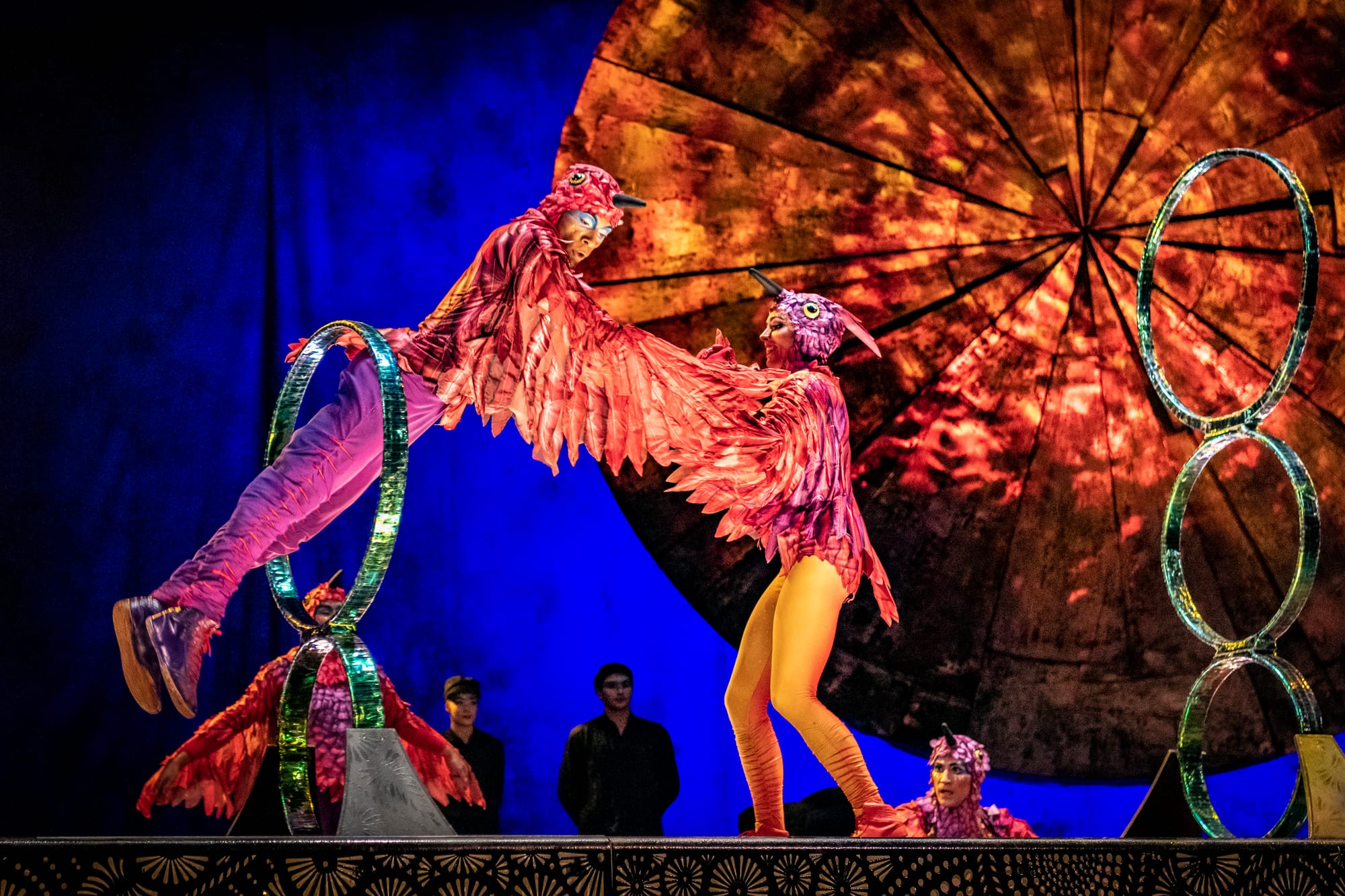
On the other hand, don’t miss the 10th anniversary touring production of Cirque du Soleil’s Luzia (Rating: ✭✭✭✭), which feels super timely with its dreamlike Mexican theme and the inclusion of a couple of soccer sequences.
It’s one of the company’s most cohesive shows, with a gorgeous aesthetic, acts that are fully integrated into the world of the show and performers that display more than one sort of talent. (The central clown, Andrii Lytvak, is incredibly versatile.)
Water is a central image, and the way it’s used will make your jaw drop to the floor. Also, it doesn’t matter where you’re sitting, since for many of the acts, the company employs two turntables, giving you multiple perspectives on the acts.
I‘ve been leery about schlepping to the Big Top in the west end (it was so much more convenient when it was more central). But it’s worth the trip. Here’s my review.
Luzia continues at the Big Top (2150 Lakeshore Blvd. West) until Aug. 30. Ticket details here
Fabulous Farb
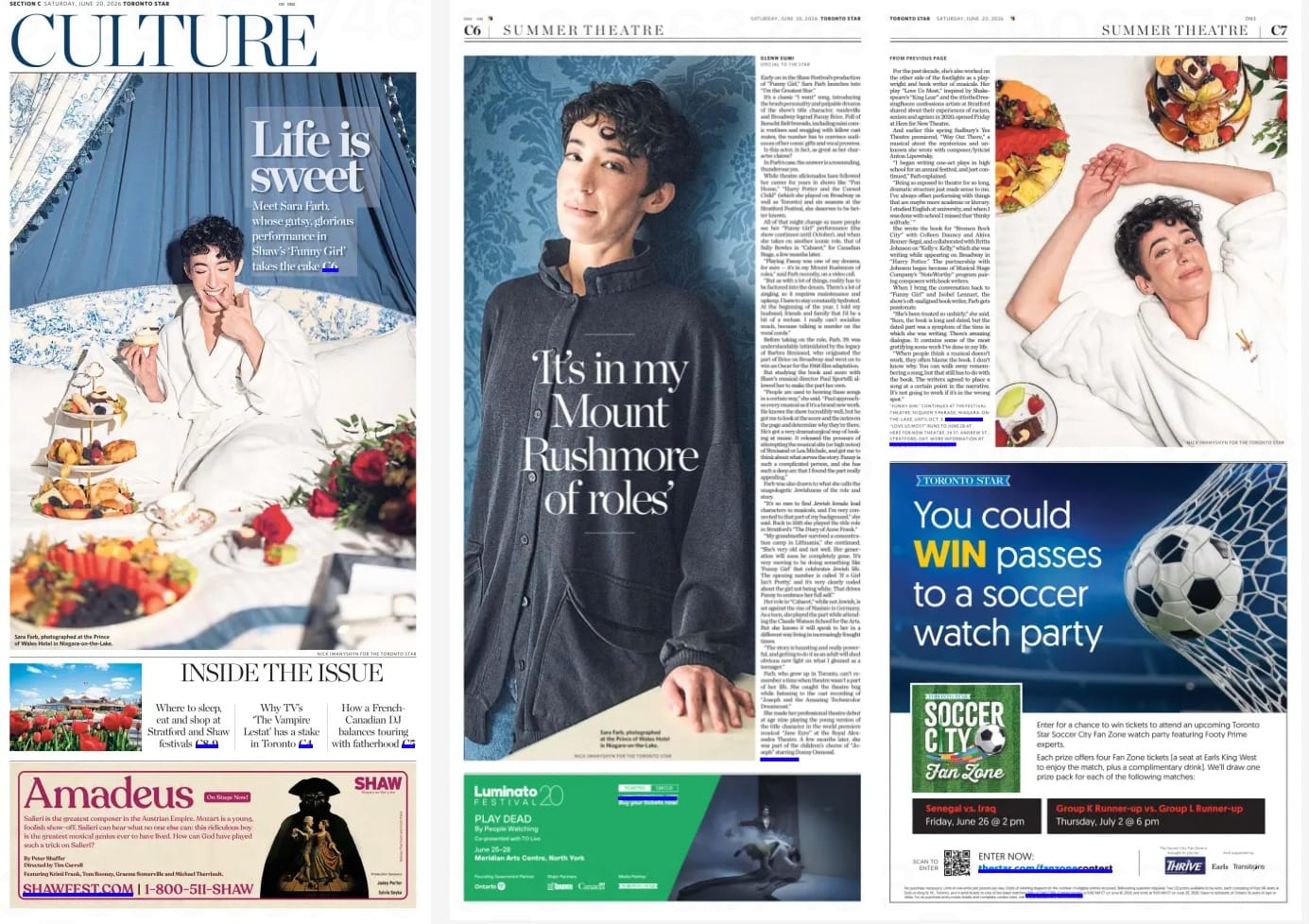
It was very cool to see my interview with Sara Farb on the cover of the Toronto Star’s Culture section last Saturday. Farb is currently starring as Fanny Brice in the Shaw Festival’s flagship production of Funny Girl through early October, and she’s taking on another iconic musical theatre role — Sally Bowles in Cabaret — next February for Canadian Stage.
To help suggest that she’s on top of the world, the Star’s culture and lifestyle editor, Laura deCarufel, dreamed up a scenario in which the star is enjoying the high life. Nick Iwanyshyn took some amazing photos of Farb in a room at Niagara-on-the-Lake’s resplendent Prince of Wales Hotel, surrounded by high tea.
The whole thing came together really quickly. The Shaw’s social media team was there for the photo shoot and put together a reel with Farb saying Fanny’s signature line, “Hello, gorgeous.” Indeed.
Here’s the article. Because of space limitations and a story’s angle, I always have to cut things. I wanted to share something Farb said about working with her voice coach Julia McLellan (who’s currently starring as Anne in & Juliet which, alas, is closing August 2).
We were talking about her disciplined regime playing the demanding role of Fanny, who’s onstage for pretty much the entirety of the show and has to sing everything from big belting numbers to poignant ballads.
“I started getting ready for the role almost a year ago,” said Farb. “My vocal coach is Julia McClellan, who’s such a good singer and coach. She helped me understand the potential and the limits of my voice and how to work with those things. I’m thrilled with what we accomplished. She’s my go-to guru on all vocal things.”
I pointed out that I found it surprising that Farb would address any vocal limitations she might have. That must be humbling, I said.
“I think it’s realistic to go into any job knowing what your limitations are,” she explained.
“Even with writing, it’s important to know that maybe you have a small budget for a show. These determine what creative choices you can make. And so with Funny Girl, it became less about being electrifying — trying to make a sound similar to (Barbra) Streisand — and more about how effective a story can be when told through these songs.
“I feel like I’m singing better than I ever have, and it’s because I’m understanding my voice in a way that I hadn’t before. Everybody has limitations, and if you don’t, I want the number of your doctor.”
Funny Girl continues at the Festival Theatre in Niagara-on-the-Lake until Oct. 3. Ticket details here.
Coming up: I break down the Dora Awards winners in a special paid-members only post; plus, I review what I’ve seen so far at the Stratford Festival. And between Toronto Fringe reviews, I hope to post a mid-festival report here.