The brains and brawn behind Heated Rivalry: The Unauthorized Musical Parody
Canadian Alan Kliffer and composer/lyricist Dylan MarcAurele are pucking the system of how to create new musicals

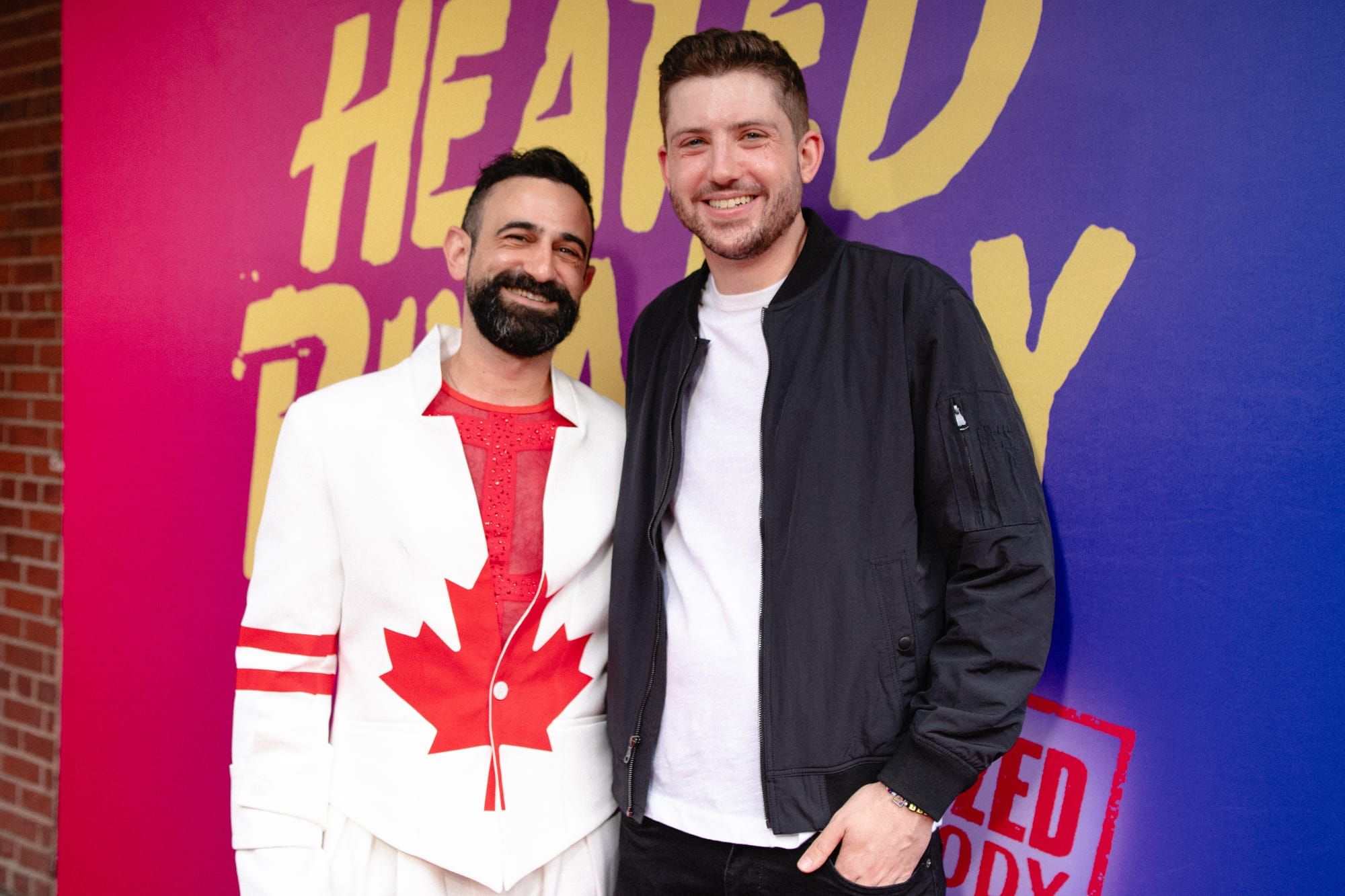
In a theatre ecology that’s full of bad news — attendance is down, shows are closing early, Patti LuPone can’t dock in Turkey or Egypt — one of the brightest lights is the success of Heated Rivalry: The Unauthorized Musical Parody.
Based of course on the massively successful Crave TV series about closeted hockey players who find love off the ice, in hotel stairwells and at the cottage, the show continues to pack in crowds Off-Broadway, where it’s been extended through Labour Day.
Another production plays the Edinburgh Fringe in August. And meanwhile, you can catch the final two performances of the Toronto concert version of the show tonight (Sunday, July 12). This same version of the show — which I caught in its first performance a few days ago — will play Just for Laughs Festival later this month.
Pretty good for a show that didn’t exist five months ago.
I spoke with composer/lyricist/book writer Dylan MarcAurele and director/producer Alan Kliffer on Zoom yesterday, with MarcAurele in New York and Kliffer, who’s Canadian, here for the Toronto concerts.
Note: there are some spoilers ahead, indicated as such.
Congratulations — and thank you. I haven’t laughed like that in ages. How did you two meet, and have you collaborated before?
Alan Kliffer: This is our first real collab, but we’ve been friends for about four or five years. Dylan reached out to me because he was connected to (comedy venue) Asylum, which I ran. I saw his MEG4N musical, which I believe he wrote in four days. I loved it and can even sing one of the songs from it still today.
Are you surprised at the success of the show? Tickets to the run of the first concert version back in March sold out in 14 hours.
Dylan MarcAurele: I didn’t know when interest in Heated Rivalry would start to dip. And so when I was initially talking with Alan, I wanted to get it up as soon as possible, because I didn’t know if people would still be talking about it in March. Now it’s July and I think the show has received enough positive attention that people are wanting to see it just as a musical. And also people are so ravenous for Heated Rivalry content and excited about the second season.
Kliffer: Yeah, there are people who want to keep the Shane and Ilya story alive, and there are people who are just learning that this is a really good musical. That’s why I think people want to see it.
Dylan, you’ve written parodies of pop culture events and phenomena before. You’ve got a Real Housewives franchise musical and, as Alan mentioned, a MEG4N musical. How do you know if something will lend itself well to parody or satire?
MarcAurele: For me, it really comes down to the material being good. I always say anybody can do what I do. When writing, you’re sort of using the same muscles you use when you really enjoy consuming something.
So watching Housewives, you see that there’s this woman that everybody keeps talking over, and it’s sad but also funny. Or with M3GAN, you wonder: “Did those people really think this doll was a good idea?” It’s all these thoughts that go through your head, whether it’s a question or a “What if?” or just loving how sweet a scene was... I use all of that to create the parody.
You must be paying attention to your social media feeds and what people are talking about.
MarcAurele: I make a lot of lists of whatever’s going on in the world that relates to a thing. I am attracted to something with a big fan base, or something that’s had a pop cultural moment, because there’s much more to talk about. So when M3GAN was happening, we were hearing a lot about nepo baby celebrities, and so the fact that Allison Williams was a nepo baby wound up being part of the plot. The more active the fan base and discourse around something, the more there is to play with.
Did you have to clear any rights with HBO, Crave or the creators, or does the phrase “unauthorized musical parody” cover all of the legal implications?
Kliffer: Yeah, this is considered a parody in full. It’s not an adaptation. With parody, you turn the material on its head a little bit. This show is really a love letter to Heated Rivalry, and there’s nothing lifted directly from the show.
I’ve heard a few times that (author of the books) Rachel Reid might be interested in coming to see it. We’d love for her to see it. A representative from HBO came, and absolutely loved it.
Dylan, how did you come up with the idea of the “Susans” narrating? I think it works brilliantly as a framing device, and it also explains why we’re watching the show.
MarcAurele: It’s so hard to get anything on its feet in New York or anywhere, and so it’s a challenge to keep the cast size manageable. If it were up to me, this show would have a cast of 20 and be at the Met. But also, in reality it’s helpful to have a narrating presence of some kind. I toyed with different approaches that didn’t work, and finally settled on these Minnesotan wine moms who embody the strange but awesome fact that the show has taken off with this demographic. It’s a celebration and love letter and a little bit of a sendup of that group as well.
The series has six episodes, and the show is about 75 minutes. How did you decide what to keep and what to leave out? You’ve got a very funny line about not including Shane’s boring dad.
MarcAurele: I usually start with thinking about the beats and structural points of any musical: the opening number, the “I want” song, the climactic act one finale, the “all is lost” moment, the 11 o’clock song. So I’m literally just mapping moments that were my favourites from the TV show onto those, and it winds up creating a somewhat similar arc.
But since musicals and TV shows have different structures, that means leaving stuff out. I was sad to not be able to include a lot of stuff, but the priority is the audience experience and making sure that it’s a fun, zippy night of theatre.
What’s really fascinating is that in many ways you’re putting into music stuff that the characters are feeling but might not say. A song like “This Fuck Was Different” is exactly what a memorable scene in the show is about, and it feels oddly liberating to hear it sung and expressed as a yearning ballad.
!!!Spoilers ahead!!!
MarcAurele: Thanks for saying that. That’s the heart of why I think it is additive to make something into a musical. What can this form do that that nothing else can? I also think the Scott/Kip audience volunteer moments are things you can only do in a theatrical production.
Speaking of the Scott/Kip scenes, they really open up the show and change the vibe of the room. Was that there from the beginning? Did you know you were going to find someone from the audience to play Scott?
MarcAurele: I was struggling for a while because I needed another body, and so I wrote a bad sequence that was just sort of Kip and Maria reacting to Scott as he had just left or whenever he wasn’t there, but it wasn’t feeling right. We had been circling the idea of having some kind of audience participation. It’s something that I like to do, but it wasn’t clear.
And then my friend Rose Oser, who is a dramaturg, was like, “There will probably be an older, hunky gay guy in every audience, and how great would it be if they came up and played Scott Hunter?” We’ve since broadened the selection process. Alan, with his improv background, was great at making that possible. I was really scared, and Alan was like, “Here’s what we do...”
Kliffer: We thought for a while that maybe the actor playing Kip could play both roles, and they would switch around. At another point, a puppet came up. Thinking about those led to what we have now.
Alan, with your experience with improv — both in Toronto and New York — you know how important it is to make the audience feel comfortable. It’s a pretty extensive scene, and the cast shows a lot of care with the volunteer.
Kliffer: The script helps, but so do the actors. In New York, Ryan Duncan and Ryann Redmond, and here Steffi DiDomenicantonio and Ron Pederson know how to take care of those people if they’re not in the right place, or lose track of their lines. You just make jokes out of what happens so everyone really feels taken care of. As soon as that audience member is picked, the audience erupts in applause, and that just makes people feel comfortable going up there doing the thing.
!!!Spoilers over!!!
Are you keeping all the theatre references in as the show travels? I’m not going to spoil them, but they get big pockets of laughs from people who get the references.
MarcAurele: Obviously Alan was a great resource for translation in Canada, and pretty much all of it stayed. In the UK, Alan has an associate who has been working with me over the past couple weeks to identify references that might not land. The good news is, you know, Waitress and the Disney musicals are well known there.
Kliffer: We’re also cutting a reference to [spoiler alert] Andrew Barth Feldman and replacing it with something else. There are some cultural differences. They don’t have Shutterfly there, but they have something called Snappy Snaps, which is fun.
There seems like a surge in queer creativity that’s breaking through at this particular moment. You’ve got the transfers of Off-Broadway hits like Oh, Mary! and Titanique, but you also have campy parodies like Ginger Twinsies. You might even say that Cats: The Jellicle Ball and Schmigadoon fall into this camp. Do you have any idea why this might be happening at this particular moment?
Kliffer: I think people are looking for joy. They’re looking to laugh. At the first performance in Toronto, an older straight couple came up to me after the show and said, “Honestly, we just needed that laugh.” I think that’s what people want now. People also like a nice 75-minute, no intermission show.
Also, at least with this show, it’s a story of hope and joy, with people in love with each other and learning to treat each other well.
All of this is happening when people are complaining so much that Broadway is unsustainable as a business model. Does this provide a different model?
Kliffer: We’ve definitely been creative from the start. Dylan and I both come from very scrappy backgrounds, and so I think that is reflected in how this show came about and is moving forward. We definitely have money behind it, but we have kept costs tight. I think there are lots of younger people trying to figure out new business models. As you know in Canada, a lot of our not-for-profits here are struggling, and I think there are new ways to do certain things that can help.
MarcAurele: One of the shows I’m working on is a musical called Lewis Loves Clark with my friend Mike Ross, and we are gearing up for an industry presentation of that in October, with the hopes that it goes to Broadway. What’s interesting is that it’s the exact opposite path of what Alan and I have taken with this show.
There’s this institutional path, and then there’s this “Do it in five minutes with no money” path. I am increasingly not sure about the institutional path anymore. I’m seeing a lot of success from people who write quickly, produce quickly, and still really care about the quality of the work.
Alan, I know you’re eventually looking for a place to present the staged version of the show for a longer run here in Toronto. But it’s been difficult, right?
Kliffer: We’d love to have some sort of Canadian anchor production. The non-profit theatres are programmed so far in advance; same thing in London. So it’s hard to grab a significant chunk of time.
If the Mirvishes took a risk and put us in the Royal Alex, that would be so cool. I think so many Canadians would come and celebrate around that. We’d also love to send it across Canada, and personally I’d love to bring it to my hometown of Winnipeg.
Note: This interview has been edited and condensed