Winter review roundup #4: Some Like it Hot, Summer and Smoke, Night at the Grand Guignol and more
Genre play inspired by a notorious Paris theatre gets the week’s highest recommendation


I find it hilarious that in the past couple of weeks I’ve seen shows with titles like Some Like it Hot and Summer and Smoke — all while we’ve been dealing with frigid temps, slush and freezing rain.
I was most curious about Some Like it Hot (Rating: ✭✭✭), based on one of my favourite films — Billy Wilder’s 1959 masterpiece — but with music by Marc Shaiman and lyrics by Shaiman and Scott Wittman (Hairspray, Smash, Catch Me if You Can) and a book by Matthew López (The Inheritance) and comic Amber Ruffin that attempts to make some of the plot contrivances more interesting for a 21st century viewer.
The premise remains the same. In Prohibition-era Chicago, jazz musicians Joe (Matt Loehr) and Jerry (Tavis Kordell) witness a mob hit, and so leave town by donning drag, becoming “Josephine” and “Daphne,” and joining an all-female band heading out of town.
Rather than rely on cross-dressing as a tired punchline, the book writers have concocted something more nuanced, especially for the character of Jerry/Daphne, who discovers something about himself that propels the narrative forward in fascinating ways.
Add in the theme of race — Jerry/Daphne, the band’s leader, Sweet Sue (Dequina Moore), and lead vocalist Sugar (Leandra Ellis-Gaston), are all Black — and you’ve got even more notes to play. Unlike the film, Sweet Sue and the band are heading west and not south, for obvious reasons.
Another thing: López and Griffin have deepened the relationship between the two friends, giving them a more emotionally satisfying backstory.
The result is a buoyant, infectiously fun musical that succeeds in its current Broadway tour, despite a few casting snafus. Shaiman and Wittman’s enjoyable score harkens back to the jazz and blues of the 30s, giving lots of opportunities for brassy solos, lively group numbers and (because Joe and Jerry had an act called “the Tip Tap Twins”) a couple of old-school tap numbers.
Perhaps because this tour has been travelling the continent for a year-and-a-half, some of the performances feel a little stale. Moore’s enterprising band leader has a couple of songs that should raise the roof, but they felt underpowered at the performance I saw. (The muddy sound system didn’t help things.)
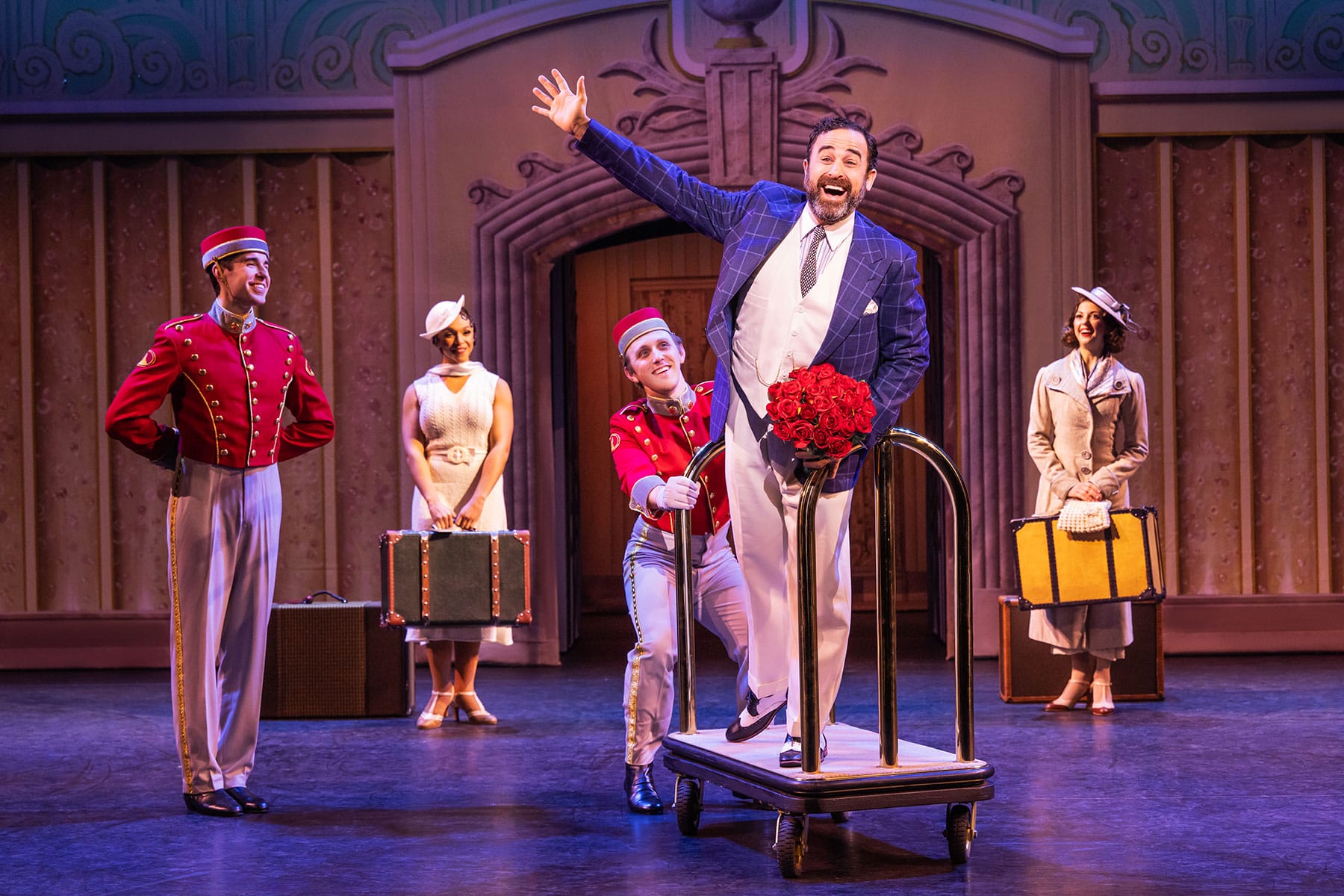
Kordell is a stylish actor who looks great in Gregg Barnes’ colourful, era-appropriate costumes. But some of their dialogue — especially as Jerry — came across as mannered and stiff. Most head-scratching of all is Ellis-Gaston, whose delivery of her lines and songs is so nasally as to be incomprehensible at times. (At first I thought this was a character interpretation, like someone doing Betty Boop or Lina Lamont from Singin’ in the Rain, but no.)
Still, there’s much to like, including Scott Pask’s art deco-inspired sets and director Casey Nicholaw’s snappy choreography; a climactic chase scene is musical theatre perfection. Loehr brings great timing and chutzpah to Joe, Josephine and a third character — it was a clever decision by the creators to stray from the film with this character (who would recognize a Cary Grant impression these days, anyway?). And I liked how the book writers played with the film’s classic final line throughout the show.
My favourite performance was Edward Juvier’s Osgood, a millionaire hotelier who’s looking for love. Joyful, spontaneous and alive to every change in the action onstage, Juvier even sells the show’s most unlikely song, a ballad with a very obvious symbolic message.
The weather might still be cold, but his performance is hot.
Some Like it Hot continues at the CAA Ed Mirvish Theatre (244 Victoria) until Mar. 15. Ticket details here

Grand old time
As per usual, I’ve been seeing lots theatre lately, trudging through snowbanks and jumping over slushy pedestrian moats. But nothing has made me that excited — until, that is, Eric Woolfe’s Night at the Grand Guignol (Rating: ✭✭✭✭).
Produced by Eldritch Theatre for a fraction of the budget of some of the shows in this roundup, it’s a stylish, fun, and hugely entertaining homage to the acts from Paris’ notorious Théâtre du Grand-Guignol, which specialized in graphic violence, lurid scenarios and twisted, demented characters.
In the opening playlet, an inmate (Natalia Bushnik) at an insane asylum (hey — it’s hard to be sensitive about language when heads are getting chopped off) is about to be discharged when a doctor orders her to spend one final night there — during which her seemingly placid (but secretly evil) inmates will likely have their way with her.
The pleasure in this vignette comes not just from the story, performances and efficient way director Woolfe lets three actors play twice as many characters on a tiny stage, but in the accompanying details. There are satiric jabs at antiquated notions about hysteria and female sexuality, and the masks — costumes and sets are by Melanie McNeill — are eerily effective in creating her rogue’s gallery of archetypes.
In the second short play, a man (Pip Dwyer, with walrus moustache) is considering a deal with a businessman (Bushnik) when he gets worried calls from his wife and son who are alone in a chalet in a forest. Woolfe, a master of genre, understands that it’s not just the main narrative that adds to the creepiness; it’s the lechery of Bushnik’s businessman, or the long, tortuous wait for calls on a rotary phone (captured amusingly by a tin can) with his wife, child and butler (all voiced to perfection by Jeanie Calleja).
The other two extended playlets are just as effective — one is set at a lonely lighthouse, the other (in what feels like a change of tone) in a suburb.
Throughout, Woolfe peppers in motifs that reveal lots about societal taboos and fears. If I have one small quibble, it’s the lack of connective tissue between the sections, either via a narrator figure (which Woolfe himself has played in several shows) or some unifying between-scenes music and lighting effects.
But this is a brilliant show, and it was especially smart to cast it with a trio of women. Women were likely objects of exploitation in the actual Parisian institution. Here, whether they’re playing “innocent” ingenues, lecherous old geezers or curious, God-fearing adolescent boys, they’re anything but.
Night at the Grand Grignol continues at the Red Sandcastle Theatre (922 Queen East) until Mar. 1. Ticket details here
Smoke without fire
Fine actors; gifted director; lesser-known play by an American theatre giant. All the ingredients for a spectacular night at the theatre are there in Tennessee Williams’ Summer and Smoke (Rating: ✭✭✭). But in the new revival by Crow’s, Soulpepper and BirdLand Theatre, something feels missing. Although it clocks in at close to three hours, it evaporates soon after seeing it — rather like a wisp of smoke.
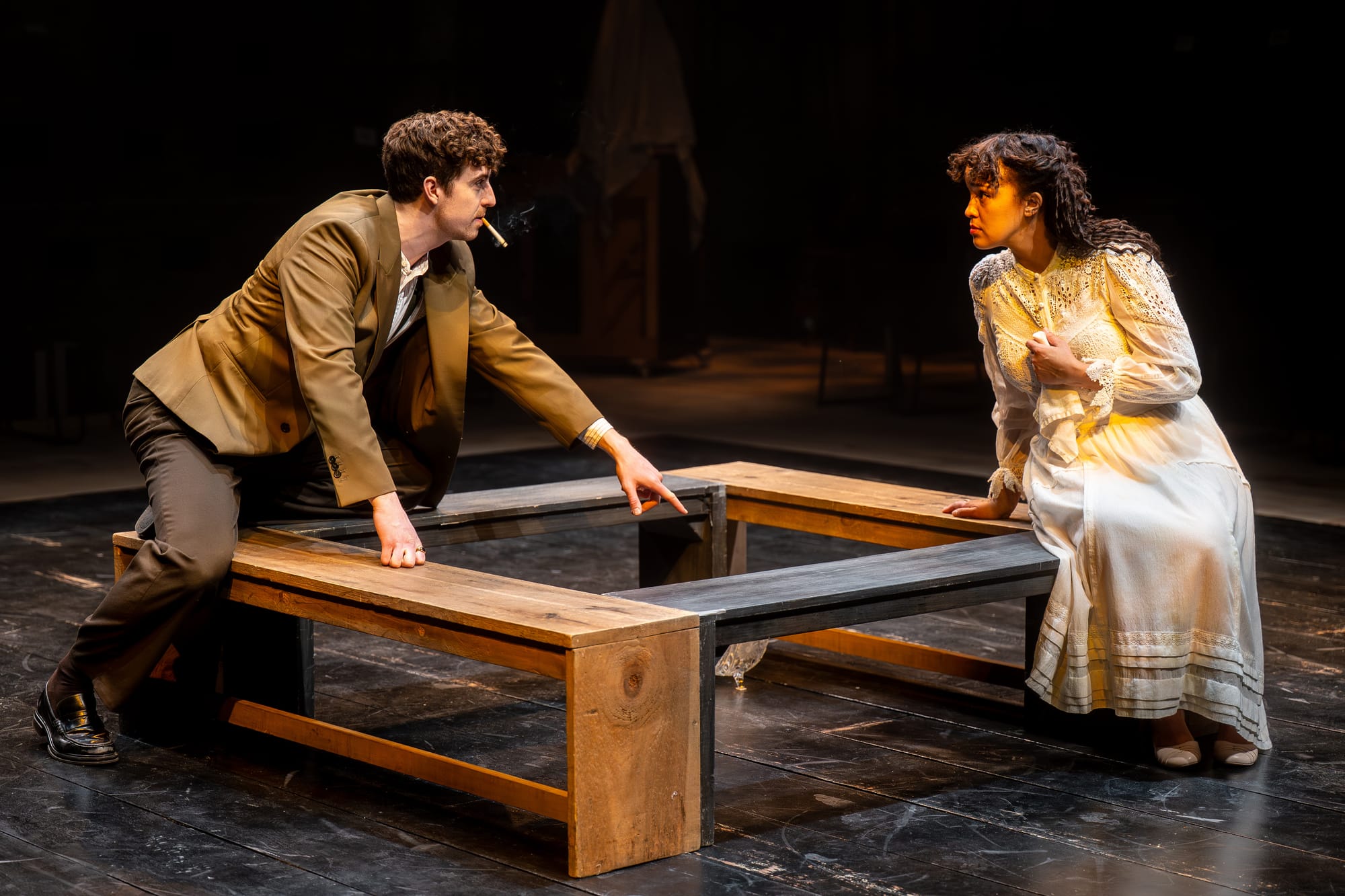
Alma (bahia watson), the highly strung daughter of a minister (Beau Dixon) and a mother (Amy Rutherford) who has suffered a nervous breakdown, has grown up in Glorious Hill, Mississippi next to the town’s physician, Dr. Buchanan (Stuart Hughes), and his son John (Dan Mousseau).
Now that John has returned home from studying medicine, they reunite at what appears to be the town square. The two couldn’t be more different; John is a hedonistic pleasure-seeker, while Alma, who teaches music, is genteel and slightly pretentious. When she invites John to a literary club (one of the funniest scenes in the play), he drinks some punch and quickly bolts for more sensual pursuits.
By the end of the play, things have radically changed in the pair’s lives. I won’t reveal what that change consists of, but unlike some of his better-known works like The Glass Menagerie and A Streetcar Named Desire, this script ends on a less tragic, and more hopeful, note.
There are shades of Laura and Blanche in Alma, and watson brings out the young woman’s fragile nature and forced gaiety effectively. (It’s fascinating to see Rutherford, Soulpepper’s acclaimed Blanche, in this world as an example of what Alma’s later life could have been.)
Similarly, John has shades of the earthy Stanley in him, albeit one with an M.D. in hand.
But in both cases, you can see the actors struggling with characters who seem more an amalgamation of traits than real flesh and blood people. Like many of Williams’ characters (and the playwright himself), they’re reacting to the repressive morals of the time, especially around sexuality. What this play lacks, however, is a climax that dramatizes its central conflicts.
In director Paolo Santalucia’s production, it’s hard to get a sense of time and place. Staging the play in-the-round gives the work an openness and fluidity, allowing settings to change quickly from staid drawing room and public square to doctor’s examination room and casino bar. (Lorenzo Savoini designed the sets and lighting.)
An unusual statue of a stone angel is worth pointing out. The headless figure includes the curvy outlines of a woman’s anatomy, but has wings attached to it, a blunt symbol of the contrast between earthly and religious matters. It’s featured in the opening scene, and returns a couple of times, but even when it’s not a part of the set it hovers over the action, suspended from above.
As a symbol, it’s rather obvious, but I wish the contrast it suggests came out more clearly, and with more dramatic force, in both the text and the rest of this uneven production. Is religion holding back Alma from embracing life fully? If so, it would be nice to get more illustrations of that.
Still, productions of this play, faults and all, don’t come along very often. There are some transcendent moments in it. And even though many of the characters feel underwritten, the actors, including Kaleb Horn and exciting newcomer Bella Reyes, do their best (the supporting actors play several roles).
Summer and Smoke continues at Crow’s Theatre’s Guloien Theatre (345 Carlaw) until Mar. 8. Ticket details here

Searching for identity
“I am defined by what you see,” says actor/playwright Coleen Shirin MacPherson midway through her intriguing, if a little unfocused, new play Searching For Aimai (Rating: ✭✭✭).
Part Parsi-Indian and part Irish-Canadian, she outwardly appears “white,” complete with blue eyes. But on every government form, she checks the “Other” box.
The play takes place in an unnamed woman’s bathroom. For some reason she’s locked in there as a winter storm rages outside. She is pregnant, and the thrust of the play seems to be about what she will tell her soon-to-be-born daughter about her mixed-race identity.
With set and props by Shannon Lea Doyle, the play’s setting might seem contrived (I don’t think we’re told why she’s in the bathroom), but MacPherson’s observations, including historical facts about Parsis and some stories about her titular great-grandmother, feel authentic enough.
The text is often poetic, and MacPherson is a warm, generous performer in the intimate BMO space at the Theatre Centre.
Director Raha Javanfar adds some nice touches. When the narrator recounts Canada’s 1952 Immigration Act, which limited entry for people from certain areas of the world (talk about relevant), she punctuates it by slamming down a toilet seat. Clever.
Laura Warren’s projections are used sparely, but effectively, to help illustrate some of the play’s themes.
But there are some odd stylistic choices; why, for instance, does the narrator pull out a microphone periodically to deliver what appears to be a stand-up routine? And there are some aspects of the narrator’s life that feel underexplored, such as her relationship with her mother (who checks in on her via phone), and the father of her child.
There’s lots of promise in this hour-long Cahoots production. I know remounts are difficult in this economic climate, but with a bit more dramaturgy and specificity, it could become something special.
Searching for Aimai continues at the Theatre Centre’s BMO Incubator (1115 Queen West) until Mar. 1. Ticket details here