Winter review roundup #2: A Doll’s House, The Last Five Years, Mischief and Dead of Winter Horror Fest
A propulsive production of an Ibsen classic and a promising debut by playwright Lisa Nasson are part of this week’s reviews

While a number of theatres wisely cancelled performances on Sunday because of the snow, let’s hope they’re back this week as the roads and sidewalks get shovelled and transit lurches back on track. There’s too much good theatre out there, and in many cases their runs are short.
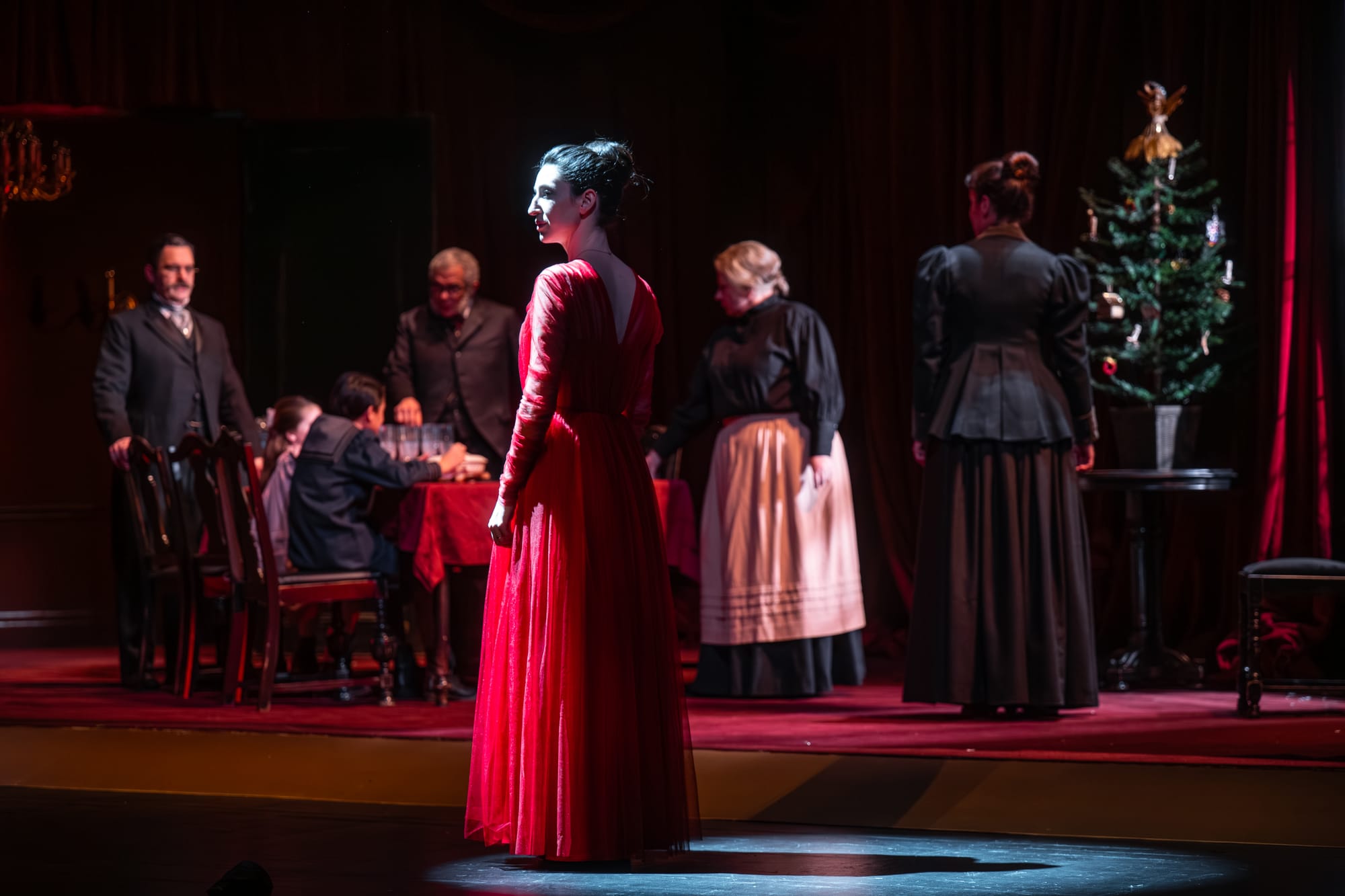
I would prioritize seeing Brendan Healy’s scorching production of A Doll’s House (Rating: ✭✭✭✭✭) over at the Bluma Appel, which as of this posting is set to close this Sunday (Feb. 1).
In adapting Ibsen’s classic, Amy Herzog (whose Belleville played here a decade ago) has modernized some of the language, cutting some scenes and characters and streamlining the narrative so that there’s a propulsive feel to the familiar show.
Hailey Gillis delivers one of her finest performances yet as Nora, the housewife and mother who — because of something selfless she did in the past — discovers her life has been a protected, and protective cage. Her Nora goes through a thrilling transformation, and Gillis takes you through every step of her change.
She’s well matched by Gray Powell, who finds just the right tone to needle us as her condescending, protective husband Torvald, as well as Laura Condlln, David Collins and Jamie Robinson, as various characters in Nora’s orbit.
Healy and his design team (sets and costumes by Gillian Gallow, sound design by Deanna H. Choi, lighting by Kevin Lamotte) have scaled the show so that it feels right at home in the large theatre: it’s both grand and intimate.
As I wrote in my review, it’s the first must-see show of the year (although a couple of commenters obviously didn’t agree).
Continues to Feb. 1 at the Bluma Appel Theatre (27 Front East). Ticket details here

Mischievous debut
There’s lots to enjoy about Lisa Nasson’s funny and thoughtful debut play, Mischief (Rating: ✭✭✭), onstage now at the Tarragon Mainspace.
Brooke (Nasson) is a young Mi’kmaq woman who works at her uncle Chris’s (Jeremy Proulx) convenience store on a reserve near Halifax. She spends her days stocking the shelves, selling tax free smokes to customers — including nearby fishermen like Fred (Devin MacKinnon) — and making small talk with her uncle and family friend Tammy (Trina Moyan).
She hasn’t yet come to terms with the death of her mother — and Chris’ sister — three years earlier. But the appearance of a mysterious stranger named Emily (Nicole Joy-Fraser) in the store’s stockroom is about to change all that. Emily, her voice amplified by sound designer Maddie Bautista, announces she knew Brooke’s mom, as well as centuries of ancestral history. And she has a message that will motivate the young woman to do something... mischievous.
Besides being a fine actor with a warm, engaging presence, Nasson is a terrific writer as well. The banter among Brooke, Chris and Tammy in the opening scenes overflows with raucous comedy. And her handling of two contrasting white characters played by MacKinnon — a working class fisherman and a (supposedly) concerned liberal urbanite identified in the show as “Good Guy” — is satire at its best. Plus, the subplot concerning demonstrations over a statue of Halifax founder Edward Cornwallis, who once issued the “Scalping Proclamation” to kill and scalp Mi’kmaqs in Nova Scotia, feels especially relevant today.
That said, some things about the script feel underdeveloped, including a rather perfunctory ending. And I’m not sure Nasson has mined the emotional potential of the story, particularly among Brooke, Chris and Tammy.
But director Mike Payette, with Joelle Peters, has given the play — a Tarragon, Native Earth and Neptune Theatre co-production — a handsome staging, brought to visual life by Andy Moro’s set and projection designs. What appears to be bones of a whale boldly frame the stage, while the projections capture everything from a galaxy of stars to, in an exciting act one conclusion, a restless, rapid-fire drive (enhanced by Bautista’s sound design) from the reserve to downtown Halifax.
If this show slowed down a bit and gave us some additional character beats, Mischief could become a more moving, and memorable, look at grief and repairing painful wounds.
Runs to Feb. 8 at the Tarragon Mainspace (30 Bridgman). Ticket details here
Musical marvel
Since it only had a short, week-long run at the newly christened Terminal Theatre (formerly the Fleck Dance Theatre), I’m very glad I caught the Toronto Stage Company/Playing with Fire Productions staging of Jason Robert Brown’s beloved musical The Last Five Years (Rating: ✭✭✭).
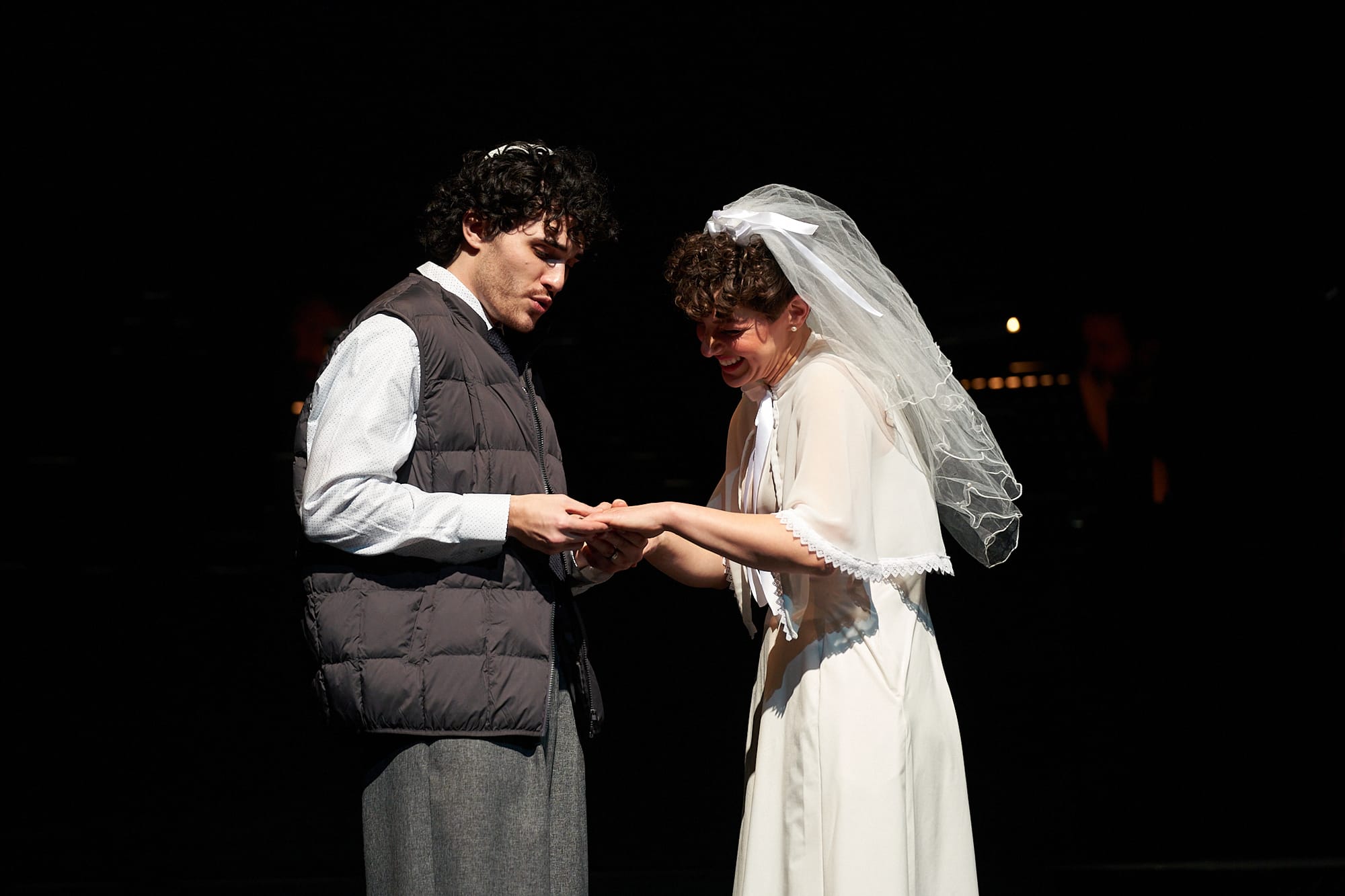
The acclaimed two-hander famously tells its story of the five-year relationship between a hotshot young novelist named Jamie (Nicolas Palazzolo) and a struggling actress named Cathy (Steffi Didomenicantonio) in two time trajectories.
Cathy’s story begins at the end of the relationship (and marriage), gradually working backwards and ending up at the euphoric conclusion of her first date with Jamie. Jamie’s story, interspersed with Cathy’s, begins at the exciting beginning and continues in chronological order to its painful end.
The juxtaposition of the two narratives makes the viewer constantly assess and reassess what they’re seeing and who or what, if anything, is responsible for the relationship’s demise. The two actors deliver their songs separately, sharing the stage and harmonizing in the same time period only in the middle of the show when they exchange their marital vows.
While the musical is brilliant — I’ve probably listened to the three official cast recordings (including Richard LaGravenese’s underrated 2014 film) more than any other contemporary musical — it can also be a tad disorienting for newcomers who don’t know the concept.
Director Luke Marty’s staging aids in the storytelling by employing two screens on either side of the stage, letting us see cellphones that show us the time-stamped texts and calls that Jamie and Cathy make throughout their five year relationship. We even see their apps and downloads and lots of selfies. While all this activity can occasionally be fussy, distracting from the work of the actors onstage, it’s also exciting and very clever.
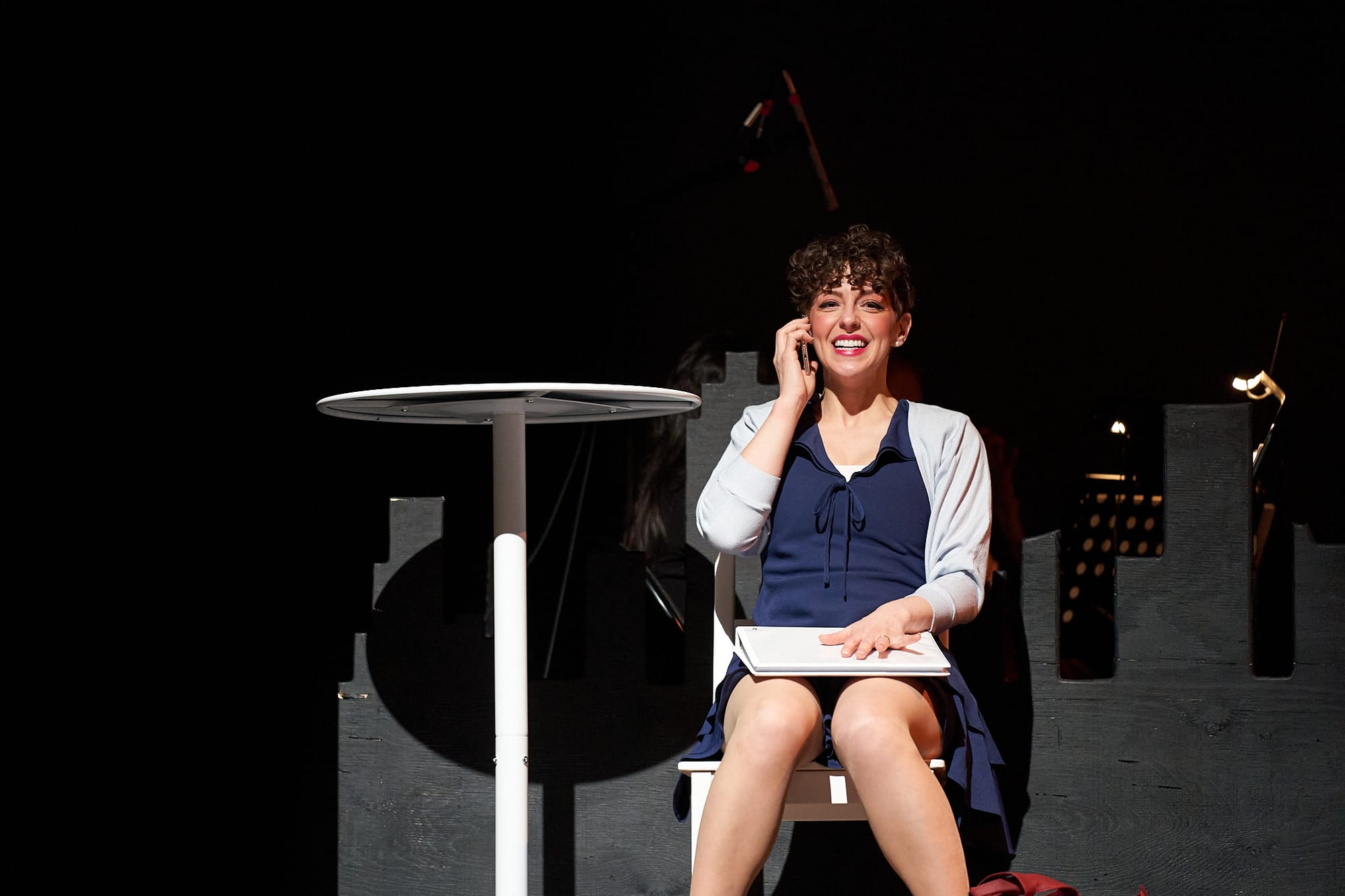
When Cathy, for instance, is demoralized by yet another unsuccessful audition, it makes sense that her lyric “I am a good person / I’m an attractive person / I am a talented person” should be there in her Notes app to remind her. And when she scans the QR code to the launch of Jamie’s book she sees for the first time her husband’s dedication to his editor, all while trying to convince herself that she’s a part of his life and success. This is a thoughtful detail.
(The fact that Marty has updated the events to the period between 2020 and 2025 explains the constant cellphone use, but it runs into problems with both the book and some added comments about writer John Updike and publisher Sonny Mehta, both of whom died before the events of the show’s new timeline. It also renders allusions in writer/composer Brown’s lyrics to Mister Ed, Daisie Mae and Linda Blair nonsensical.)
Didomenicantonio, so winning in the Toronto production of Come From Away, was vocally challenged at the mid-week performance I saw, continually singing flat. But she made up for those shortcomings with a deeply moving performance that gained in power (and pathos) as the show went on.
Palazzolo, a young actor unknown to me, handled the score’s huge vocal demands effortlessly, soaring in his extroverted moments and, as his relationship crumbles, finding real despair and pain in his guilt and remorse. Keep an eye out for him.
Marty’s multi-platform set worked well enough, but I’m not sure we needed the lighting effects (by Ryan Davy) to literally represent a clock in Jamie’s Schmuel song. Music director Robertx Wilkinson and the six-person orchestra brought the score to life vividly, although they could have used a few more rehearsals. And there were some nice details in Nola Chaters’ costumes, particularly in illustrating Jamie’s evolution from scruffy hipster to young professional.
I know some people complained about the production’s steep tickets prices. But after having seen all the work that went into this ambitious staging, I understand why costs were high.
Let’s hope we see more work by these companies at this resurrected theatre.

Deadly good
I’m a huge horror fan, and so I welcomed the opportunity to sample the inaugural Dead of Winter: The First Toronto Horror-Theatre Festival, co-presented by the Spindle Collective and Eldritch Theatre. As I’ve written here several times before, apart from Eldritch, I don’t think there’s enough genre work being produced in Toronto theatre — and it’s a huge missed opportunity.
Although I only caught one part of the two-part festival, the 90-minute show proved an infectiously atmospheric way to pass the time during the chilly season.
Perched in a corner of the intimate space, Eldritch’s resident ghoul, Praetorius Wuthergloom (Eric Woolfe), introduced the short plays, as well as a musical guest, with his usual crabby (and highly amusing) barbs.
The shows themselves were the real treat. Things began well with Natalia Bushnik and Kathleen Welch’s spilleHOLLE (Rating: ✭✭✭✭), an absorbing tale mixing fairy tale and adolescent angst. A German mother (Welch) spends her time spinning her wheel, teaching her daughter (Bushnik) to do the same. But when the girl goes through adolescence — including a menstrual scene that brings to mind a famous Stephen King novel — she neglects the spindle, until she discovers reserves of power within her. The writing is swift and efficient, and the performances and production haunting.
Next came Aaliya Alibhai’s The Matchmaker (Rating: ✭✭✭), a simple tale about a psychic matchmaker (Natalie Stephenson) who sees a new client (Medha Arora) who wants to meet someone but is holding something back. The psychic also has a big secret, which comes out in the funny-scary conclusion.
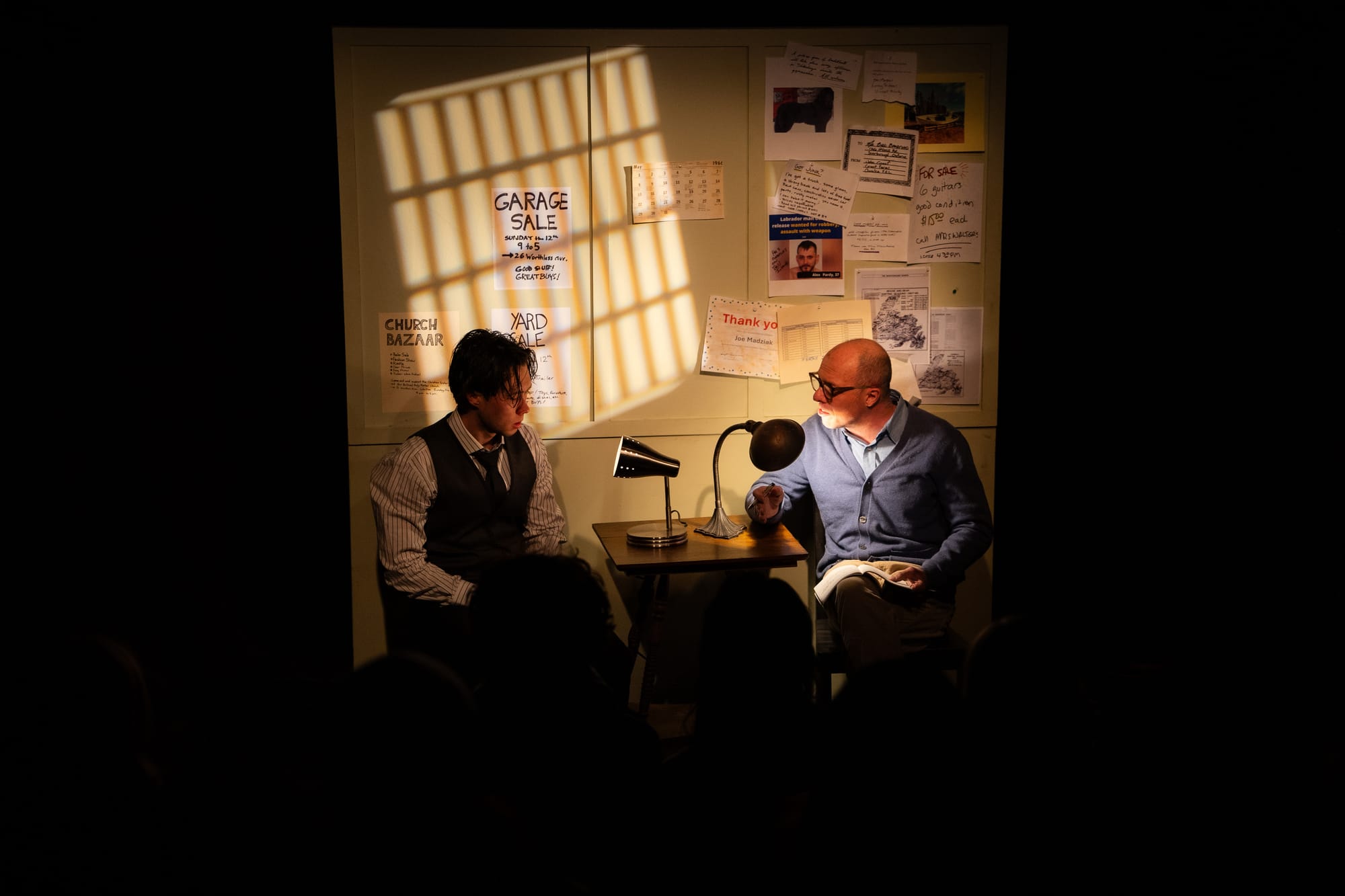
After a moody musical interlude by Andra Zlatescu that opened the second half, David Ferry’s The Hag of Bell Island (Rating: ✭✭✭✭) closed out the night in style. A Maritime newspaper reporter (Michael Kash) interviews a man (Aaron Macpherson) who claims he fell asleep in Munich, Germany and woke up in Newfoundland. What happened? Perhaps it had something to do with the mythical hag of Bell Island.
With Ferry directing, the situation was established quickly and convincingly, and the design — including Christo Graham’s sound — enhanced the feeling of uncertainty and dread. The final jump scare was so effective that it made you forgive the slight misogyny of the material.
I hope the festival becomes an annual event. For future editions, I’m not sure it needs a musical act. Woolfe’s hosting, and the creativity/ingenuity of playwrights working on a smaller scale, is entertaining — and scary — enough.