Flying solo at the Toronto Sketch Comedy Festival
Jon Blair, Cam Wyllie and Emily Jeffers discuss what it’s like going it alone onstage

Think of sketch comedy and you probably imagine an ensemble of half a dozen actors sharing the stage in various groupings. One sketch might feature four people. Another could pit male cast members against female ones. Perhaps to mix things up, one troupe member might come out with a guitar to sing a song.
But what about solo sketch artists? There’s no being the straight person to let someone else get the big laughs. No taking a breather backstage between scenes. If a show kills, they bask in the glory; if it bombs, well, there’s no one else to blame. It’s all them, all the time.
As the Toronto Sketch Comedy Festival kicks off this week, I talked, via Zoom, with three terrific solo sketch artists about happily going it alone: Jon Blair, Cam Wyllie and Emily Jeffers.
The festival runs March 4 to 16. Ticket details are here.
Without consulting your festival blurb, can you describe your SketchFest show?
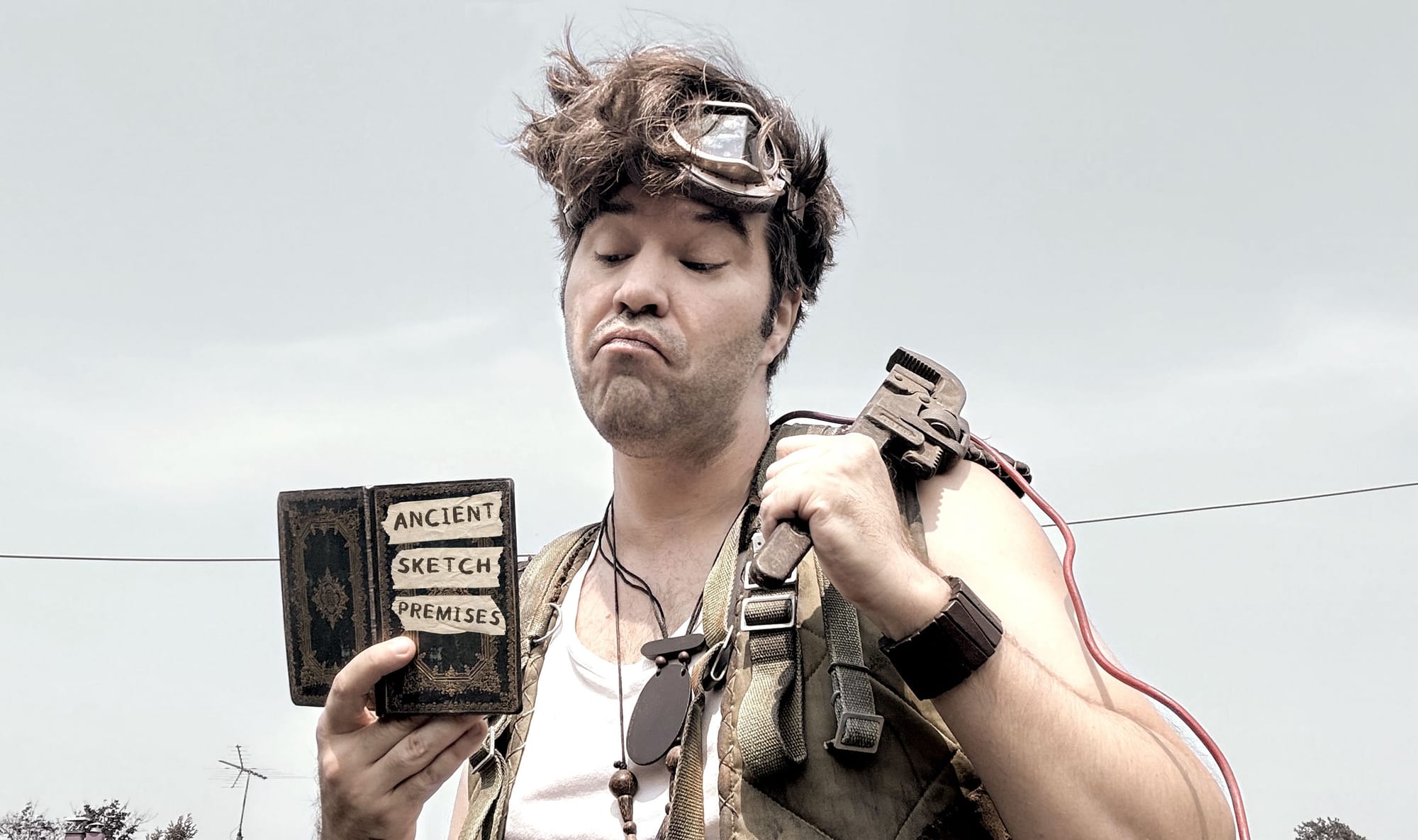
Jon Blair: It’s half sketch show, half play. It’s a play about a sketch show, and it takes place in a Mad Max-style, post-apocalyptic world. It’s about a former TV comedian still trying to pursue a career in comedy after the world has ended, and still trying, maybe a little naively, to change and fix the world through his art. It’s a bit about the function of comedy and what it’s for and what it can and can’t do for us, and what we should and should not expect from it.
Cam Wyllie: Mine is little bit more of a traditional sketch comedy show. It’s a collection of my favourite new works over the last year, featuring a parade of broken men and women just trying to do their best and get by in a world that is seemingly designed to break people down and hold them back. At its core, it’s about optimism, but outwardly it’s just stupid jokes. I like to think of it as a Trojan horse: I bring these jokes into your brain, and at the end of the show, hopefully, you’re like, “Oh, why am I feeling so empathetic?”
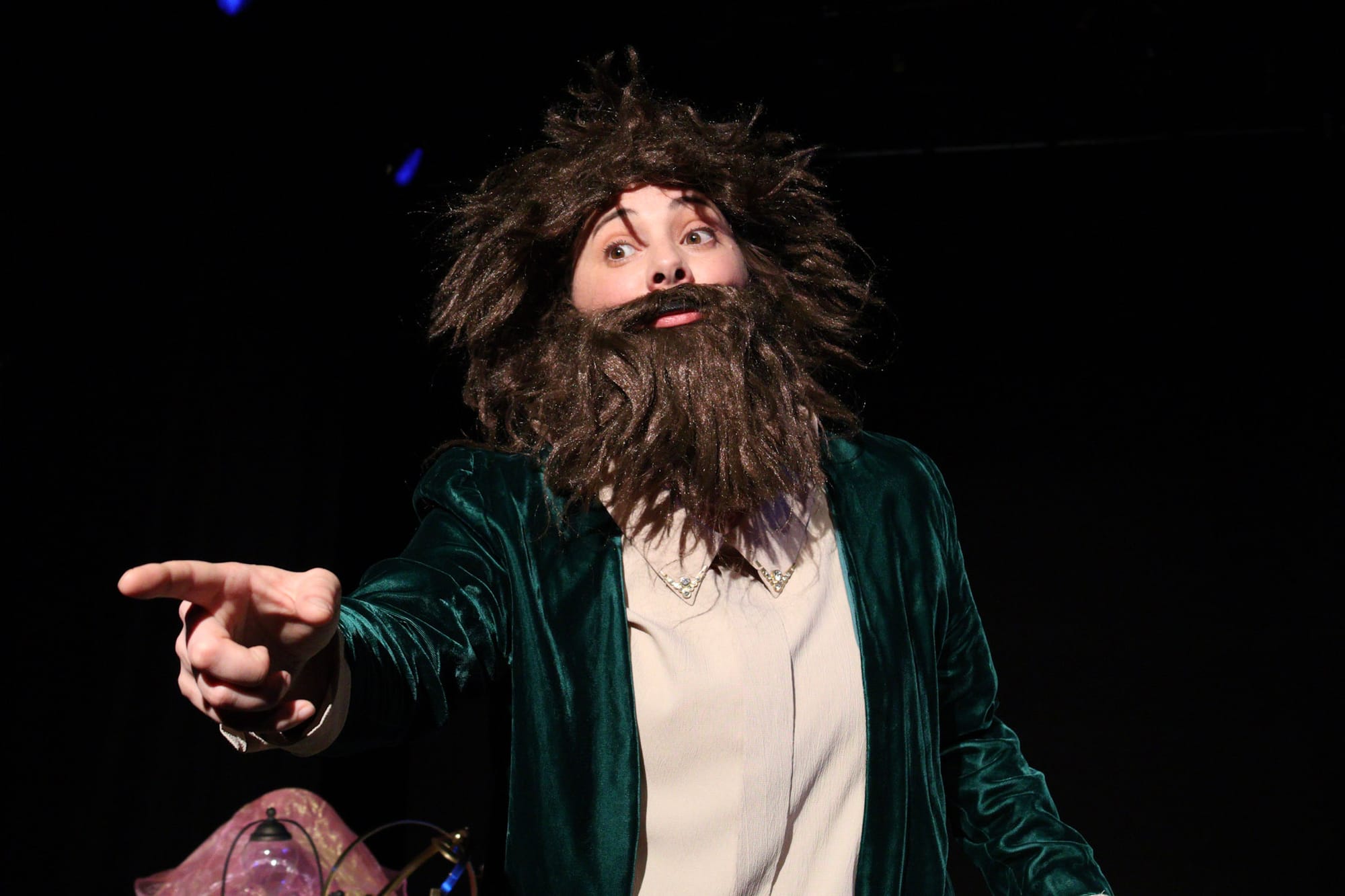
Emily Jeffers: My show is a solo character comedy — more like a clown show, but we don’t need to get into specifics about the form. It’s about a sort of Renaissance scholar/genius who is trying to teach people math because he realizes there’s a knowledge gap in terms of what people know and what can be understood. He tries to teach people math, but then the audience kind of discovers that he’s not really great at math himself. The show leads the audience through a half hour lesson of sorts about math. But it’s very, very silly.
Why solo sketch? Is it just easier because you don’t have to adhere to other people’s schedules?
Blair: That’s a big part of it. My solo sketch was borne of necessity. I was in a TV writer’s room on the East Coast, and everyone else was a stand-up. On weekends, they’d go to Yuk’s or The Carleton and do time onstage, and I was the only one who couldn’t. So I started thinking about a bunch of the sketches I had written for The Sketchersons over the years, and figuring out how I could pare them down to monologues.
Being able to take your show anywhere — the portability of it and the ease of scheduling — is definitely a bonus.
Wyllie: Jon used the word “necessity,” and that really resonates with me. I started doing solo performance coming out of COVID-19 lockdown. The landscape had changed so much, and my old partnerships didn’t make as much sense. So the question was, “What can I do that’s within my control?” And I thought, oh, of course, I can do a show that’s just me — because I am already me.
Jeffers: There’s a creative freedom in working by yourself. You get to explore all your own little interests, idiosyncrasies and weirdnesses. When you take that risk, you carry the load and responsibility. But you also get to bask in the glory when it works.
So for me it’s been partly to develop my own voice, but also the circumstances of the pandemic. I started training in clown a few years before the pandemic, and then going through it, when we were all trying to figure out our own ways of doing it, it became easier to work by myself and do solo stuff.
Do you work with directors — or someone to give you that “outside eye”?
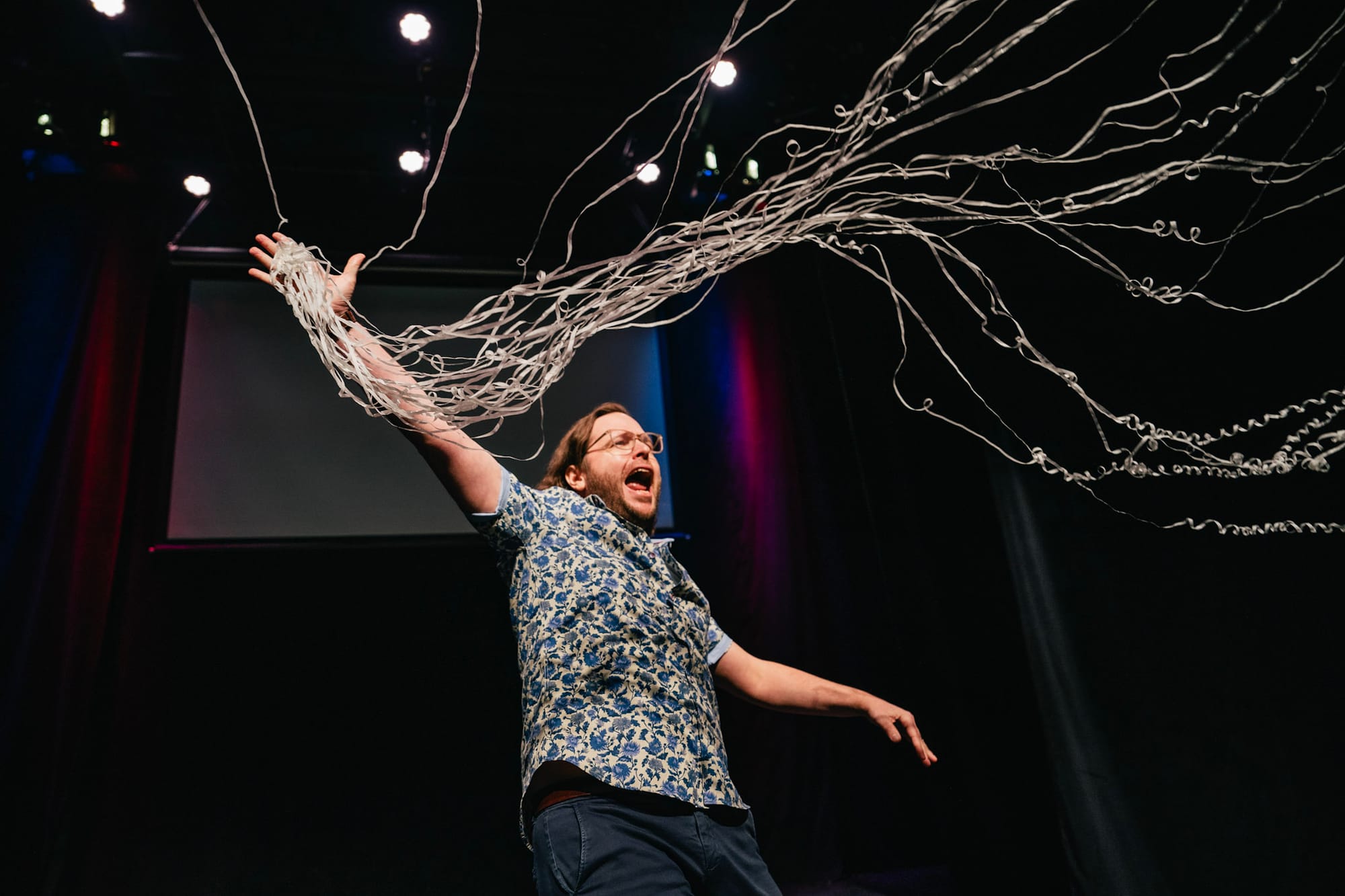
Blair: I don’t work with a director, but that would be a great next thing for me to do. Generally, I annoy partners and friends with my proto-ideas, and say, “Hey, I’m working on something,” and give them the idea. If it makes them laugh, or at the very least makes them not go, “That’s terrible,” then fine. A lot of the time I feel, “Well, I guess we’ll see what this is like once it’s onstage.” Now I’m working on Monster Island, which is a solo character showcase, and that’s kind of the show’s ethos. Maybe it’s not always great to have the audience be the very first arbiter of whether something you’re working on has merit. But, like Emily said, it’s nice when it works well.
Jeffers: From a clown perspective, that is absolutely how you see if something works or not: you toss it to the audience, you try it onstage. If it doesn’t work, you have to survive it and figure out maybe why, or finesse it in some way. Just discover your pleasure in that moment.
When I was developing my first Bitty-Bat show for Toronto SketchFest in 2023, I worked with Isaac Kessler, and we worked trying to discover who and what the character was. He was like a coach more than anything. For my second Bitty-Bat show, which is the one that toured, I worked mainly alone, with some help from Allan Turner in dealing with plot and storyline. For The Mathemagician, my outside eye was Hana Holubec, who’s a brilliant comedian and actor. It was really nice to get some of her feedback on some of the bits I was working on.
Wyllie: I think working with a director is important. I tell every artist that I work with, solo or ensemble, that it’s a worthwhile investment. I worked with a couple of directors once or twice until I found the person who just made the most sense to me: Johnny McNamara Walker. He’s been just a delightful fit for what I do. “Director” doesn’t always feel like the right descriptor. He really feels like a creative partner. I love that I can come and sit him down and perform a show that’s maybe 90% there, and we can work together to delve into that last 10% that I would never be able to see myself.
He’s got such a brilliant writer and performer brain, and he sees things that I’m naturally doing, that I don’t clock, and tells me to dig into it, bring out something more. I wouldn’t have been able to do that on my own. He’s also got a great eye for the stage picture and really heightening emotional moments. He brings out things that I might do on instinct or by mistake, and he makes sure everything feels purposeful, polished and presentable.
Do you have any solo sketch inspirations — people you saw onstage who made you want to do this, too?
Blair: Early on, I saw a lot of great solo work from The Laugh Sabbath crowd, people like James Hartnett and Kathleen Phillips. It was so cool to see them get up and do stuff on their own in a sort of character way. When I started doing stuff that was more sketch, with a beginning, middle and end, I tried to keep their examples in mind. They really got you invested in a character, as opposed to just plot. They could take one character and make you care about the character more than the premise. That was a huge inspo for me when I was starting out.
Wyllie: Jon, you were such a huge inspiration for me. Seeing someone who was in my wheelhouse of humour, doing things I wanted to be doing, and seeing that someone could leave a huge ensemble like The Sketchersons and go on to do work that was more specific and consistent — that was amazing.
Jeffers: Honestly, both of you inspired me. What I really admire and am inspired by is your your commitment. You really give it everything, and are also really great actors. Another thing is your silliness. I love indulging in silly and whimsy. It goes a long way.
Blair: Thanks, you two. Emily, I remember I saw you perform The Mathemagician in Montreal in this theatre on Ste-Catherine. You were about to go on as the Mathemagician. It was the funniest and most stressful thing I’ve seen. There was this really narrow spiral staircase, I was walking up, and you were at the top in this enormous costume and beard, holding a bunch of lanterns and scrolls. As nice as you possibly could, you told me to please get out of your way because you had to get downstairs.
Jeffers: I hope I at least said it in character: [in mock grand tones, sounding like Gandalf]: “Get out of my way!“
How have Instagram and TikTok changed comedy?
Blair: I think they’ve changed people’s... I don’t want to say attention spans, but how long they expect a sketch to be. During the pandemic, I did something called Now More Than Ever, which was a sketch show, like a half hour sketch show made up of three-to-four minute sketches. I filmed the whole thing in horizontal, which was a mistake, because later everyone started watching vertical video. The other thing is all those bits are three or four minutes long — as long as I would do them onstage, or as long as something you might see something on SNL or a sketch show.
These days, you’re trying to hit a sweet spot of, at maximum, two minutes. It makes you edit a lot more. For a while, I was sort of like, Oh, well, I’m just gonna put what I’ve got online, and whatever will be will be. If people dig it, they dig it, and if they don’t, they don’t. I still do that, but I admit, I am trying to write a little more to a shorter frame, because that’s what people expect.
I don’t really like catering to whatever the popular thing is on social, but the reality is, a lot of the time, with festivals, they look at that sort of thing. Social media helps get my work out there, and I like getting my work out to people. So if there are different boxes you have to fit into, I’m willing to do that. But a little minute-long thing doesn’t come naturally to me.
One thing that we have kind of learned with Monster Island is how much time you can save by saying, “And now this character...” on the screen. I would spend two minutes setting that up onstage. It’s like learning a different language.
Wyllie: How much time have we got? (laughs) There are so many people who make great content, who really understand how to shoot something, how to capture visual storytelling in these formats. You put them on a theatre stage, and they stink, because they don’t know how to perform live.
I think comics have to make a decision: which stage am I going to be good at? Where am I going to put my attention? You’ve also got to think: what are your goals for being online? Is it just a place to put something you believe in? Are you there as an artist, or is this marketing? Are you trying to build an audience you can monetize? Are you trying to leverage followers into TV pitching and getting a developmental deal? When you start layering business into the art, as with Instagram and TikTok, things can get muddy.
It was freeing when I decided to focus on live sketch comedy. For me it was about doing the work that I love and not worrying about having to sell it online, just worrying about what’s happening in the room. There’s nothing wrong with deciding, “Hey, I’m going to get on TikTok and aim for a million followers and turn this into a worldwide tour.” It’s hard, but it’s possible, and if you do that, my God, the world will open up to you. But there’s also nothing wrong with saying, “I care about what happens in this cabaret room with 40 other people and maybe changing 40 lives this night.”
You all perform at other festivals, sketch or otherwise. Are there any other acts you recommend people see during SketchFest?
Wyllie: I’d love to shout out a couple of out-of-town acts. First off is Amanda Xeller from New York. She’s an incredible solo performer — the energy, chaos and emotion she sneaks into scenes is so impressive. She was one of the first solo performers I saw, and really inspired me with her approach. Every show feels new and different.
I also want to recommend a group from from Denver called Big Ol’ Mess. I’ve been lucky enough to do some festivals around North America, and I think they’re the best ensemble working today. They all complement each other. They are so able to share the spotlight together and have this incredible balance. They take big swings, and you just go along for the ride with every bizarre choice they make. I’m so glad SketchFest paired me with them for one of their shows.
Jeffers: I’ve gotta give some love to Legally Brown, who were the co-headliners at my recent Spotlight at The Second City. They’re so dedicated, so funny. They’re trying to come up with a new sketch show every quarter, or something like that. They’re just on a tear. Red Hot Sili Peppers is so fun. Vivek Srikanthan does amazing solo sketch. 24 Double B are hilarious. These are all acts people should see.
Blair: I would definitely recommend Comedy Dance Chicago, who are exactly what they sound like: they’re comedy, dance and they’re from Chicago. They’re so funny and so incredibly skilled — technically and physically. The way they merge comedy and really good dance is just fantastic. I had the pleasure of seeing Two2Mango’s show “Colonial Circus” last year at the Edmonton Fringe, and they’re back with a new show. The two of them have these huge, elaborate bits they set up that are just wonderful. Lou Laurence is one of my faves. She’s a wonderful musician, so funny and talented — her work is so heartfelt and makes you feel things.
Taking Up Space by Nkasi Ogbonnah is one show I’m really excited about. I directed Nkasi in her first solo show last year, and I was involved early on in the creative process of this one, so I’ve seen all the sketches already, and I’m here to tell you they’re great. And of course, I'm always excited to see Two Draculas. I will never, ever get over them. It’s Chris Locke and Tim Gilbert as two Draculas doing a parody of sketch comedy. It should infuriate me, but I love it — every time I see them, I love them.
Anything else you’d like to mention, perhaps for people considering doing solo sketch?
Wyllie: If you have an inkling to try solo sketch, do it. It changes your perspective on the art form, and it forces you to be brave in a way that you maybe thought wasn’t possible working in a larger troupe. It’s opened up and changed my life so much. If you think, “Hey, maybe this is for me,” write a two minute scene. Find places around the city where you can perform it in a low stakes setting. Just take the plunge.
The Toronto Sketch Comedy Festival runs March 4 to 16. Ticket details are here.
This interview has been edited and condensed