Richard Lee travels to Middle-Earth (and back again) at Stratford
The actor takes on the biggest role of his career as the small but mighty title character in The Hobbit

This post is sponsored by the CBC podcast PlayME. The full audio version of Nicolas Billon’s play The Neighbours and an interview with the playwright are now available for streaming and downloading through your favourite podcast app. See more below.
Richard Lee is destined to have a magical year at the Stratford Festival. Two of the three shows he’s starring in feature enchantment, spells and dreams.
He has a small role in A Midsummer Night’s Dream, in which he plays Philostrate’s associate, called Burdock (he’ll also be understudying several roles).
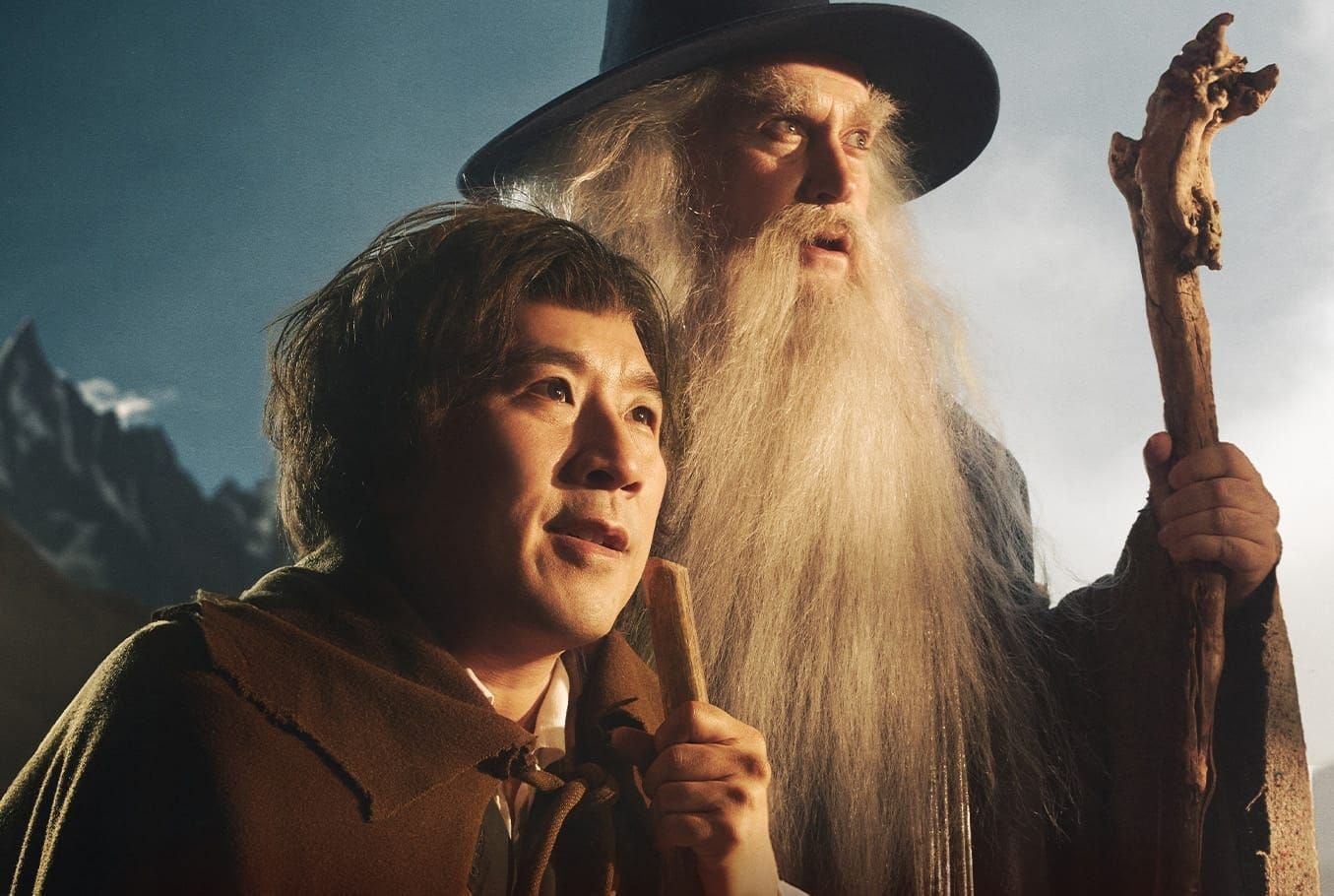
But in The Hobbit, Kim Selody’s adaptation of J.R.R. Tolkien’s beloved children’s novel, he stars as the titular Bilbo Baggins, who’s hired by the wizard Gandalf and 13 dwarves to travel to the Lonely Mountain and help them reclaim treasure from the evil dragon Smaug.
No stranger to Toronto theatre audiences, Lee — who’s now based in Ottawa — has starred here in WIGHTS, The Humans, acquiescence and The Winter’s Tale. He’s also busy as a fight and movement designer. But this Stratford premiere is one of the biggest roles of his career.
I talked to him in that busy period during previews of both shows; he begins rehearsals for Jovanni Sy’s The Tao of the World, which opens in August, soon.
How have rehearsals and previews been? You were last at Stratford in Peter Pan more than 15 years ago.
It’s been really lovely. It’s been a hot minute since I’ve been at the festival. We’ve had audiences of all ages come through the house, and they’ve been wonderful. The extended timelines of rehearsal schedules in rep theatre feels so long. We started in February, and didn’t preview until a few weeks ago. We were certainly ready for audiences, and having them come and enjoy the show has been a delight.
What was it like to rehearse two different shows at the same time? Does it play with your head?
Two years ago, I was in two shows at the Shaw Festival, including some understudying. I’ve been out of practice. My daughter Eponine was with me at the time, and I remember, we’d wake up, go into rehearsal or a preview, have a quick turnaround, walk our dog, go eat a sandwich, and literally launch into rehearsals for the rest of the day.
This time around, I’m carrying the show in a very different way as Bilbo, and I’ve been very intentional about things. The festival has been lovely in ensuring I have what I need to be able to be focused on the show. And while my part in Dream is smaller and easier, I’m still giving 1,000% of myself to it. I want to be present in each moment when I am there and I feel like I’m accomplishing that. But it’s practice, practice, practice.
That said, it’s nice to be fully immersed in the art. We talk all the time about living the dream, and I am certainly doing that right now.
How excited were you when you got the role of Bilbo?
I knew when auditioning that they were looking for a BIPOC actor for the role. When my agent called me, I was a little in disbelief. It’s such an iconic role. I think when people think about Bilbo and hobbits in general, they don’t necessarily picture non-white faces. So I was ecstatic and beyond myself.
It’s also been interesting, 25 years into my career, to think about choosing and taking on roles that are meaningful. I live in Ottawa now. I have a family that needs and wants me there. As I get older and I realize the things that are important in my life, things that take me away from my family need to really align with what I want to say in the world.
I read the script and immediately felt it was a piece I wanted to participate in. In a time when we are living with the threat of war, in a time of turmoil, where greed seems to be pervading every corner of the universe, Tolkien gives us a small character that makes daily choices that help move us forward. I’m happy to be a part of that.
How much of a Tolkien fan were you before? How well do you know the Middle-Earth Extended Universe?
You know what’s funny? Before this, I’d really only spent time with The Lord of the Rings movies, which of course are great works of art. I remember kind of reading The Hobbit when I was in high school. I recently discovered audiobooks. I downloaded the books narrated by Andy Serkis, which are amazing.
So the short answer is: not very much, but holy mackerel. I’ve spent countless hours now diving down YouTube rabbit holes, learning more and more about the letters Tolkien wrote, The Silmarillion.
I’m no Lord of the Rings expert, or even, like, high level nerd. I’d say I’m an entry level nerd. I can participate in the conversation and know what people are talking about. But I’ve really enjoyed all the research. It’s really enriched my understanding of fantasy in a way that I hadn’t before. I played Dungeons and Dragons. I loved R.A. Salvatore’s Legend of Drizzt series. This has been a really touching way to return back to the genre, to focus on something that every fantasy author draws on.
I noticed the title has a trademark on it. How strict is “Middle Earth Enterprises” in approving things — script, design? Do they have their hands in everything?
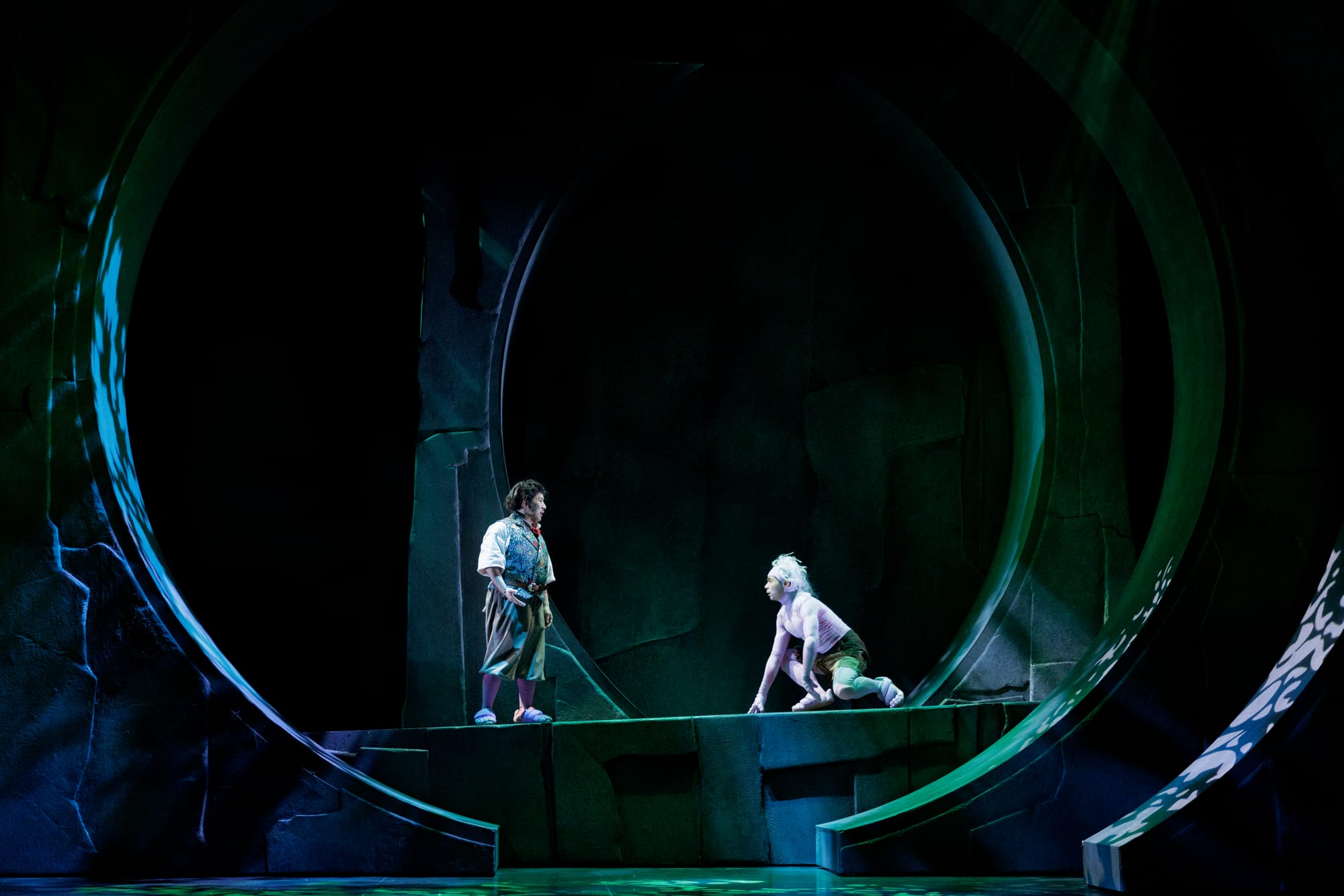
I don’t know all the intricate details. I’ve heard snippets here and there. The Tolkien estate has been very open to how folks wish to interpret the story. They’re not like, “Oh, Sting has to glow blue when goblins are near.” They’ve been good. When people imagine Bilbo, and they remember the movies, they might feel, “Oh, he’s gonna be in the velour coat, in tones of green and maroon. Ting [-Huan 挺歡 Christine Urquhart, costume designer] and Pablo [Felices-Luna, director] have decided on a more 1870s, kind of William Morris, paisley aesthetic and tone. As Bilbo, I’m Asian, and some Asian touches are in there too, in a way that is unobtrusive and delightful. And I think this applies across the board for everything from the marketing to the production. I think as long as the estate is kept abreast of the what the choices are, they’ve been open and great in what they’re looking for.
What can you say about the stage adaptation? Filmmaker Peter Jackson notoriously took three films to tell the story.
The wonderful thing about theatre, and this production, is that it really elevates all of the fantastical, magical points in the storytelling. There are touchstones you need to include — the trolls at Rivendell, the chase across the Misty Mountains, Smaug. This play does an amazing job at capturing the breadth of the story while retaining its emotional core. The play takes the audience on an emotional journey. Of course the adaptation couldn’t be word-for-word. But if you’re talking about the epic-ness of the journey, the heart of what it means, I think Kim’s play and Pablo’s production absolutely succeed in a way that gives me tingles. It does a really great job at that, and does it in the way that only theatre can.
For something like The Hobbit, you must have audiences who know the story and universe intimately, and others who have no idea what a hobbit or dwarf is. How do you appeal to both?
I think you have to keep in mind that this is the festival’s family show. That’s the entry point. But if you’re a Tolkien scholar or super fan, there will be lots for you to take away. There are little nuggets in the show; just one small example is that at one point someone calls Gandalf “Mithrandir,” which is his Elven name. If you are really into the lore, you will understand one of the characters in the book that’s really only mentioned briefly, Old Took, who acts as a sort of narrator here, taking the audience through the journey. I think it’ll be interesting to see this character and this relationship come to life within the world of the play.
Can you tell me something about the look of the show, which features everything from human-sized characters to otherworldly creatures?
I don’t want to spoil the look of Smaug, but watching how they bring this creature to life is incredible. Every night so far, I’ve heard audiences going “Wow” because they can’t believe that something they know is not real comes to life onstage. The trolls and spiders, too — Pablo and the designer have found ingenious ways to approach them, that spark the audience’s imagination. We’re not presenting slices of real life; we’re theatre. That’s why it’s so f– ing exciting.
Kids are notoriously honest audience members. If they don’t like something, they’ll let you know. How are they responding to previews so far?
We’ve been sharpening and honing moments during the previews, discovering what it is that we want to say but also remembering that it’s a zany adventure. The kids and the adults are getting all the jokes.
The scariest thing as a performer is when you get nothing — shuffling seats, or they’re bored. It’s been delightfully eerie and revelatory to look out at the audience and feel them on their edges of their seats, engaged with the story. I have a moment in the second act when I get to look out at the audience as I’m waiting for Smaug. Everyone — parents, children, old folks — is enthralled. They’re just agog.
I don’t know Pablo Felices-Luna’s work as a director. He’s done a lot of theatre for young audiences out west. What is his process like?
Pablo and I were both at York University together — he was doing graduate studies when I was in my fourth year of undergrad. I’ve enjoyed working with him a lot. He’s earned my trust as a performer. There was a moment early on in rehearsals where I was fussing and fretting about something, and I asked him if a moment was working.
He gave a really considerate answer. He basically said, “Allow yourself the opportunity to see where this goes. And if we change our minds later, we will just change the direction. I’ve been watching you put things together, and I think all the choices you make are lovely. Trust that no matter what you do, it will always be compelling.”
Two days later, he gave me a small note about my decision. And I realized that he is watching things and thinking about the show all the time.
He is recognizing the offers we’re making and putting them into the matrix of the show. He is patient beyond all belief. He is there watching me to ensure that I’m not going to embarrass myself out there.
You touched on it earlier, but why does this play resonate so much right now?
The creatures in the book, the philosophies in them — they’re just so relevant. They show us to be brave, to keep moving forward, that it’s not just about fighting to win a day. What does winning a day even mean? It’s about making the right choices as we move forward in life.
This conversation has been edited and condensed
The Hobbit is currently in previews, opens May 30 and runs in rep until Oct. 23 at the Avon Theatre, 99 Downie, Stratford. Ticket details here
The Neighbours comes to your ears
Back when the new CBC PlayME season was announced, I was excited about experiencing audio versions of plays most theatregoers recognized: recent hits like Pamela Mala Sinha’s New and Akosua Amo-Adem’s charmer Table For Two. I was also gratified that two stone cold Canadian classics, Michael Healey’s The Drawer Boy and Ins Choi’s Kim’s Convenience, would be captured in audio form, drawn from recent revivals.
The wild card was The Neighbours, a new play by Nicolas Billon. It was programmed for the Tarragon winter season, but no one had seen it yet. Hosts and producers Laura Mullin and Chris Tolley chose it for inclusion based on the script alone.
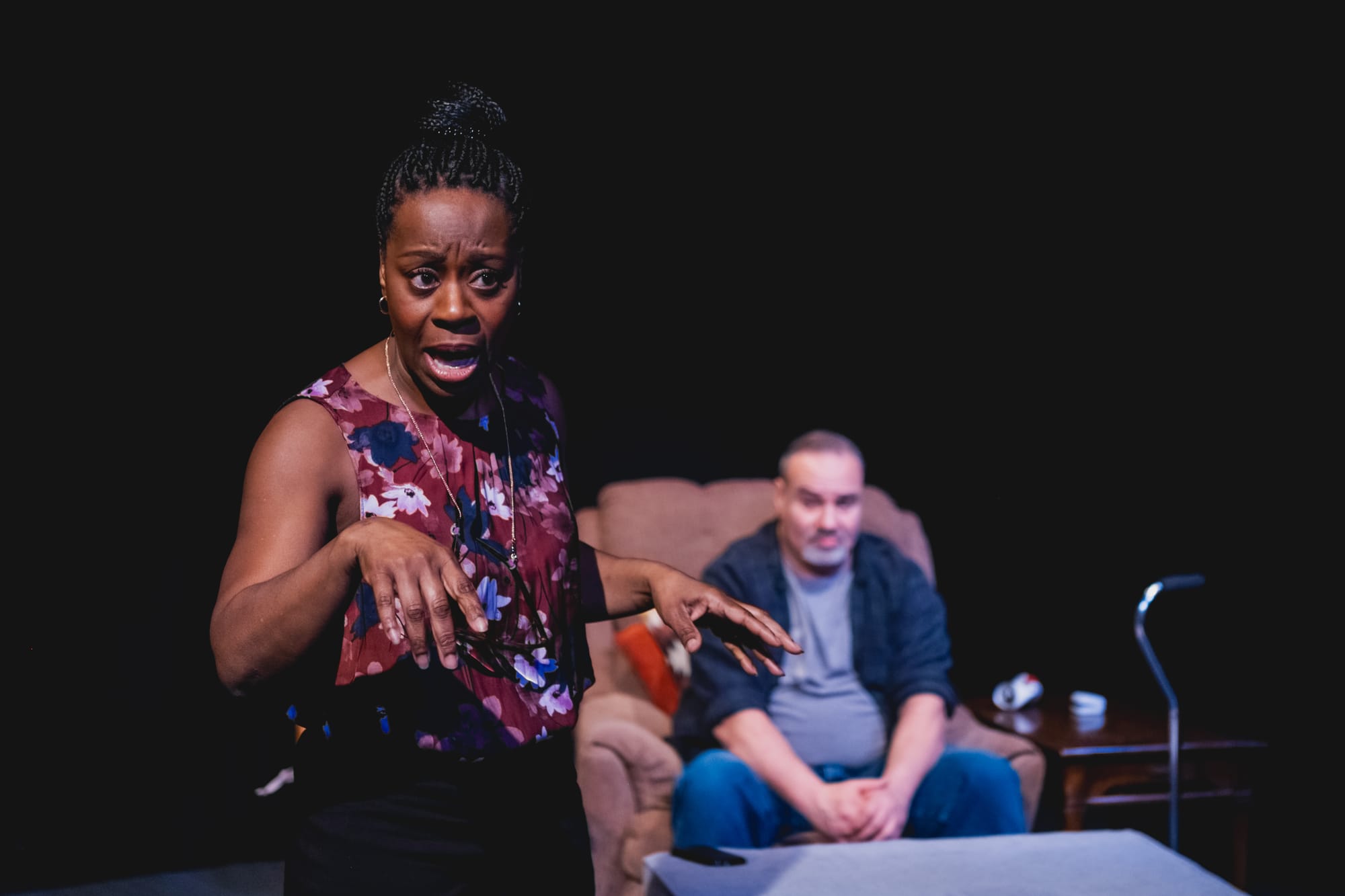
The play turned out to be terrific. Just last week, the Toronto Theatre Critics’ Awards jury (of which I’m a member) named it the best new Canadian work of the 2025-26 season. And it will doubtless be up for several nominations at the upcoming Dora Awards (announced June 1), particularly for leads Ordena Stephens-Thompson and Tony Nappo, who play Denise and Simon, a middle-aged couple who discover their neighbour kept a missing local girl in his basement for over a decade.
The play works very well in audio format, although it takes a while to understand that the couple is addressing us, the audience. Mullin and Billon discuss this presentational style in their fascinating conversation, which dropped on CBC PlayME today.
Direct address, says Billon, “is one of the few things we can do in theatre that no other medium can do as well. It forces you to be complicit in this story that you are being told. It’s not asking you to take sides... but you naturally do that.”
Billon has lots of insightful things to say about the work. It’s Denise’s play, he admits, since her journey is bigger. And “direct address” isn’t the same as “confessional.” The latter implies the characters know some things, whereas in a play like The Neighbours, the characters are discovering things at the same time the audience is.
Mullin gives us a glimpse of the recording process — and how laser-focused and committed the actors were in the studio. When they had found a version they were happy with, they went back to re-record one or two early sections. The performers then proceeded to continue through the entire play. She called the taping electric.
Mullin and Billon also talk about the most controversial thing in the play and production: the inclusion of a third character, a neighbour named Au Yeung Wei (Richard Tse), who remains onstage for the entire show but is mostly silent.
Billon struggled with whether to include the character onstage, and for a while he even considered representing him with a puppet since the character is a puppeteer. Ultimately it was director Matt White’s decision to include him in person.
As Billon says: “Even though he says very little, his presence is felt during the entire show. If he’s not onstage, it’s a different play.” I agree completely.
Billon’s appearance is also significant because he was the first playwright who agreed to have one of his works captured and presented for the podcast. He and Mullin discuss that, as well. His earlier works Butcher and Iceland are available on PlayME and PlayME+.
The Neighbours marks the final podcast in PlayME’s season. I’ve loved revisiting plays and discovering things I missed when I saw them live. Or, in the case of The Drawer Boy and New, hearing different actors in certain roles.
I also love hearing the playwrights discuss their work in such granular detail. There are too few places to read or hear about that. For years at NOW, editors would tell me and my late colleague Jon Kaplan: “There’s too much about the process” when reading early drafts of interviews with playwrights and directors. And while writing for general interest publications, there’s the temptation to make things accessible to as wide an audience as possible. There’s also a tendency to dumb down: What’s your favourite neighbourhood? Where do you like to write?
Theatre is an art, and art should be taken seriously (even if it’s a comedy). Part of that involves discussing process, inspiration, and the hundreds of tough decisions that go into a script before it hits the stage.
As always, you can find this season’s plays and interviews, including a special bonus episode interview with Nightswimming’s artistic director Brian Quirt, here. During the rest of the year, that same link will take you to earlier plays.
And thanks to CBC PlayME for sponsoring a half-dozen posts. Full disclosure: this commentary is generated completely by me, and is not directed, overseen or pre-approved by anyone associated with the podcast.