Review: Merrily We Roll Along takes a good thing and ruins it
Maria Friedman botches her own acclaimed stage production of Stephen Sondheim’s musical in this misguided screen version

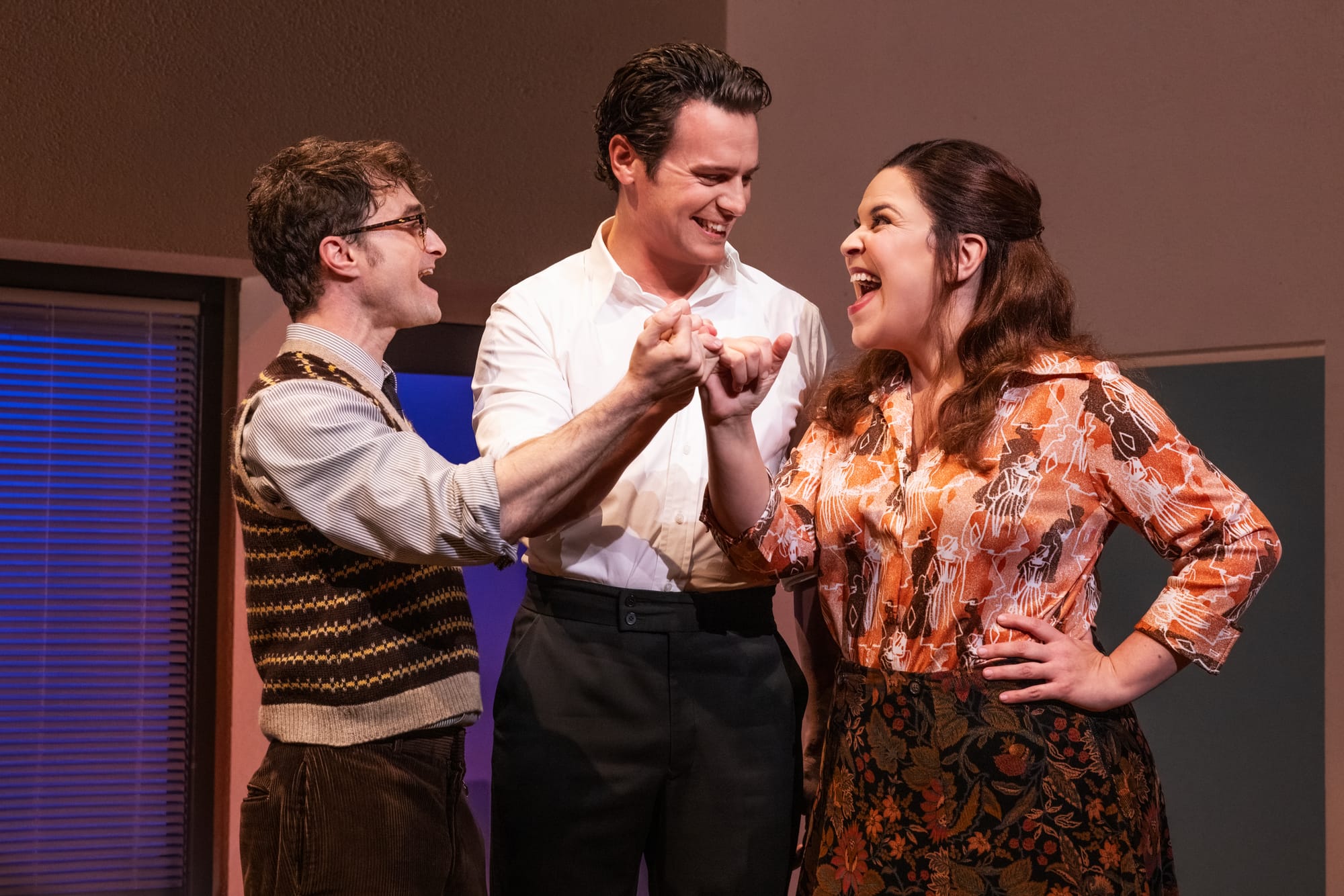
It doesn’t take very long to realize that Maria Friedman’s film version of her successful 2023 Broadway revival of Stephen Sondheim and George Furth’s Merrily We Roll Along (Rating: ✭✭) isn’t going to work — and I’m not even talking about the fact that she decided to cut short the mood-setting, anticipatory overture for one of Sondheim’s best scores.
I won’t bore you with too many details about Merrily’s notorious Broadway flop in 1981. You’re reading a theatre newsletter, after all; I’m sure you know it by now. (If you don’t, I highly recommend Best Worst Thing That Ever Could Have Happened, a documentary about the show by original cast member Lonny Price.)
The TL;DR synopsis is: bombed on Broadway in 1981, Sondheim kept reworking it, and then Friedman (sister of producer Sonia) directed a successful West End revival at Menier Chocolate Factory. With some tinkering, that production, recast with some big names, transferred to New York, first at New York Theater Workshop and then transferred to Broadway’s Hudson Theater, where it broke box office records and went on to win four Tonys.
When news broke in the summer that that same production would be captured in a pro-shot, produced by Fathom Entertainment (the same company that helped make the terrific screen version of Hamilton), I was thrilled.
If only someone had told Friedman — a fine stage director and actor — how to direct a film.
Pro-shots work best when you’re not really aware of them. In successful ones like Hamilton, Come From Away and (many people’s gateway Sondheim musical) Into the Woods, the camera essentially shows you what you’d be looking at if you had great seats in an actual theatre. You get a proper sense of the stage picture, the context in which the characters find themselves. For extremely intimate moments, it might give you a close-up or two.
The best pro-shots capture the excitement and energy of being in the theatre. You hear laughter and applause after numbers. The CFA pro-shot is especially poignant because it was captured right as Broadway theatres were reopening after COVID-19 shutdowns; you can feel the audience’s joy and gratitude for witnessing live theatre in their applause.
Friedman doesn’t want you to be aware of the audience. In production notes sent to reviewers, we were told that “the perspective is that of a classic Hollywood production, with emotions conveyed not only through Sondheim’s memorable music but also through our seeing them on the actors’ faces, and through staging that provide a close-ness to the story.”
That’s fine and well, and I’m sure that when Richard Linklater’s actual film of Merrily is released in 15 years or so, we’ll get lots of opportunites to see Paul Mescal, Ben Platt and Beanie Feldstein’s faces as they are/were captured over the two decades of filming — an amount of time that’s reflected in the show’s storyline.
But for this Merrily, we’re watching a stage version, so why pretend otherwise? When the camera swoops in and shows us close-ups of individual chorus members as they sing the title song — seemingly directly to the camera — it awkwardly resembles those moments in beauty pageants when contestants smile and tell you what state they’re representing.
Sure, it makes sense to give you close-ups early on of Jonathan Groff’s Frank Shepard. He’s the central figure. When we first meet him, he’s a 40-year-old film director with a brand new hit movie, surrounded by West Coast sycophants.
As the show progresses with scenes in reverse chronological order, we see how he got to where he is: compromising on his artistic ideals, cheating on his wife and becoming estranged from his son, and most importantly, losing best friends Mary Flynn (Lindsay Mendez) and Charley Kringus (Daniel Radcliffe), who were once inseparable.
So it’s fitting to show us Frank at this late stage, a tear rolling down his eye as he (perhaps) thinks about what he’s given up to be at the top. (Friedman filmed several live performances in June 2024, but also captured a few scenes with no audiences, and I suspect this tear-shedding scene was part of the latter.)
But everyone gets the close-up treatment. At times, there’s so much facial skin on the screen it feels like you’re at a dermatologist clinic.
In songs where lyrics are spread among the ensemble, such as the transition numbers where we go back in time, the cameras dart around like someone trying to capture a tennis game.
To be fair, some scenes work nicely, such as the early one in which a fatuous live TV host interviews Frank and Charley about their collaboration and Charley rants about how Frank has wasted his potential as a composer to chase money in Hollywood.
Radcliffe, whose celebrity likely helped secure both the revival and this film version, has a reckless, neurotic air as he mimics playing the piano and typewriter, showing why he won a Tony Award for the featured role. But equally powerful is how stony and silently fuming Groff’s Frank is.
I’ve seen the show several times, including the off-Broadway version of this one, and what’s crucial is finding an actor to play Frank who’s sympathetic. Groff, who also won a Tony, starts out all fake Hollywood insincerity, complete with dark shades, but as we move backwards we see his armour and self-defences fall away, exposing the idealistic young man. He lightens his voice, he carries himself differently. He’s open to life.
The scene in which Frank and his (future ex-wife) Beth get married right after their lively “Bobby and Jackie and Jack” cabaret number — a fitting reference to Kennedy era optimism that we also know ends tragically — works beautifully.
For one thing, it takes up most of the width of the stage, and Friedman has to film it that way. But also, Mendez’s Mary — who’s been in love with Frank for as long as she’s known him — gets to sing along to Beth’s “Not a Day Goes By,” but for an entirely different reason. It is soul-crushing, and Mendez, whose Mary is another example of wasted opportunity, delivers a definitive version of the role.
Even with the pro-shot’s serious flaws, the artistry of the show comes through. Look at how a lyric like “Feels like an ending / but it’s really a beginning” sums up the entire structure of the show. Even Mary’s wry comment about her friendship with Frank — “We go way back... but seldom forward” — essentially illustrates the show itself.
And the material’s theme about youthful optimism coming up against harsh reality is always poignant; who among us hasn’t thought of the ways in which our lives have turned out, for good or ill?
Any preservation of this production was going to be a good thing. But wow, what a missed opportunity. To quote another bittersweet passage from the show (and its biggest hit, recorded by no less than Frank Sinatra): they had a good thing going, going... gone.
Merrily We Roll Along screens in theatres beginning Dec. 5