Review: A Fine Balance gets a powerful theatrical adaptation at Crow’s
Chris Abraham’s staging of Rohinton Mistry’s bestselling novel will haunt me for months

Bravo to Toronto theatre companies for going head-to-head against TIFF. For decades, there was an unwritten rule that no cultural event in Toronto could compete with the festival’s glitz and glam — at least during its opening week.
Thankfully, we’re beyond that now. The theatre season launched in fine style last week, with several openings. Which reaffirmed my decision last year not to apply for TIFF media accreditation, even though I covered the festival for two decades. (Honestly, it’s a relief not to have to line up for 9 am weekend Press & Industry screenings, or have a 20 minute interview with an actor or director cut down to 10 and then 8 minutes. Rest assured, I will cover theatre-related films in this newsletter when they’re released during the year.)
I’ll get to the other openings later this week, but firstly: there could be no starker contrast between red carpet excess and what’s onstage at Crow’s Guloien Theatre in its season opener, A Fine Balance (Rating: ✭✭✭✭), a deeply moving adaptation of Rohinton Mistry’s epic 1995 novel set during Indira Gandhi’s Emergency measures in 1975.
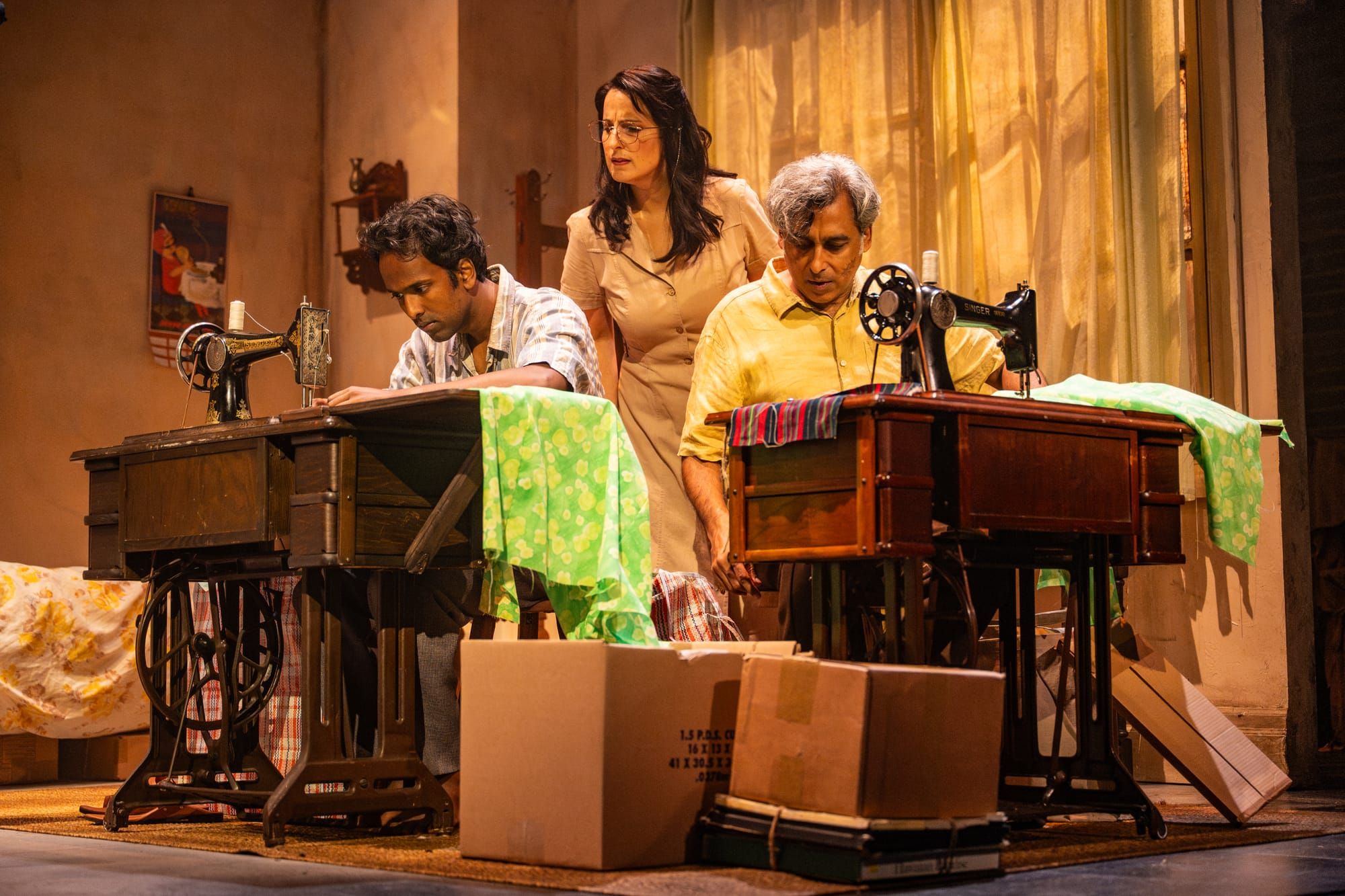
Playwright/novelist Anosh Irani has condensed the sprawling 600+-page book to a play with a run time of just under three hours, focusing primarily on the central characters: four very different people sharing a cramped Bombay flat.
Widower Dina Dilal (Zorana Sadiq), in order to establish some independence from her controlling brother, has rented out a room to Maneck (Siddharth Sharma), a childhood friend’s idealistic teenaged son, who’s there to attend college. She’s also hired two tailors, the obsequious Ishvar (Anand Rajaram) and his embittered young nephew Omprakash (Ben Yoganathan), to fulfill orders from a fashion export company.

The fact that Dina is essentially running a business from her home causes the frazzled rent collector, Ibrahim (Hussein Madhavji), to be suspicious on behalf of the landlord, who’s hungry for any excuse to evict tenants and jack up rents. Meanwhile, Ishvar and Om find shelter of a sort in a makeshift shack near the railway station, where neighbour Rajaram (Sugith Varughese) instructs them on how to squat on the train tracks to relieve themselves each morning.
I read the book a couple of months ago in preparation for interviewing Irani, who told me he was not employing flashbacks or using a narrator figure. Instead he centres the story mostly on the interactions among the four characters in the flat as they evolve from strangers to something resembling a family.
Initially, Dina treats Ishvar and Om — who come from a lower caste — differently, having them drink their break-time tea from cups no one else uses. While making deliveries to the export company, she even locks them inside the apartment — partly to hide them from Ibrahim’s prying eyes, but also because she doesn’t trust Om not to follow her and see who her supplier is.
Maneck, meanwhile, grew up in relative prosperity in an idyllic mountain-side town that, over the years, has succumbed to development. Through his unseen college friend Avinash, a student protester, and the injustice he sees befall Ishvar and Om, he gets a sobering look at what’s happening in the country.
The latter bear the brunt of the government’s Emergency edicts, which include a “beautification program” that ejects them from their home, as well as horrific measures to help decrease the country’s soaring population that I won’t reveal here.
In the novel, learning about the characters’ backstories and cultural backgrounds gave them lots of depth, adding texture to their interactions with each other at Dina’s flat. Irani’s dialogue does a lot of that work — with the occasional bit of obvious exposition sticking out — and the beautifully cast actors add layers of humanity and subtext to their lines.
As I wrote in my Fall Preview post last week, I couldn’t imagine anyone but Sadiq as Dina. She captures the woman’s fierce independence and pride and, as the play progresses, her growing protectiveness of Ishvar and Om. It was clever of Irani and director Chris Abraham to open the second act with a scene in which Dina and Maneck visit her overbearing brother Nusswan (Madhavji) for money; we only need to hear his blustering pronouncements (he approves of Gandhi’s Emergency measures) and see the way Sadiq physically shrinks and lightens her voice for us to understand their decades of disagreements.

Irani is less successful in filling out Ishvar and Om’s world. One of the pleasures of Mistry’s novel is its epic, Dickensian sweep, where secondary characters take unexpected journeys. In the play, characters like Rajaram and the severely disabled Shankar (Madhavji) pop up but don’t have much of an arc; and one important figure — the Beggarmaster, who essentially buys up the unhoused for a cut of their earnings — is mentioned but not seen. When we meet someone named Thakur (Varughese) late in the play, we don’t know his history with Ishvar and Om, and so his actions don’t resonate the way they do in the novel.
Still, Madhavji and Varughese bring these various secondary characters to life with effortless skill. Sharma is well cast as Maneck, whose world view is changed more than anyone else’s. And Rajaram and Yoganathan create unforgettable portraits of men stretched to their limits who — to quote the title, which comes from another unseen figure — are trying to maintain a “a fine balance between hope and despair.”
Under director Abraham, the show’s design is hugely effective. Michael Gianfrancesco’s set lays out the few rooms in Dina’s humble flat, but also suggests the bustling city around it, complete with girders and beams. A clever track mechanism downstage allows for a few efficient, never obtrusive, location changes.
Imogen Wilson’s lighting and Thomas Ryder Payne’s sound design enhance the feel of the city and the dangers outside Dina’s flat — including governmental announcements from loudspeakers. The way one brutal scene in the second act is lit, scored and staged will haunt me for months. (For readers of the book, the use of some classical music early on in the play acts as a subconscious reminder of Dina’s short-lived marriage with how she met her husband, Rustom.)
Kudos to Ming Wong, whose costumes clearly indicate a character’s socio-economic background. For a play/book in which tailoring and fabric play such a key role, the way she has stitched together the clothing into a patchwork quilt of human experience is masterful.
I was skeptical that Mistry’s novel could be condensed into anything less than an eight-part TV series. I’m happy to be proven wrong.
A Fine Balance continues at Crow’s Theatre’s Guloien Theatre (345 Carlaw) until Oct. 25. Ticket details here
Ticket winners
Congratulations to Andrea L. and Martin W. Andrea won a pair of tickets to To a Flame (Sept. 22 to Oct. 4) by correctly pointing out that Erin Shields’ play was a reinterpretation of Poe’s “The Fall of the House of Usher.” Martin won a pair of tickets to Bootycandy (Sept. 30 to Oct. 17) by answering that the show’s director, Jay Northcott, was a contestant on Big Brother Canada.