Some spring cleaning, Part 1: Three classics revisited
Intriguing takes on Cyrano de Bergerac, Miss Julie and the Medea myth heat up Toronto stages


This post is sponsored by the CBC podcast PlayME. The full audio version of Michael Healey’s classic play The Drawer Boy and an interview with actor Tom Barnett are now available for streaming here or through your favourite podcast app.
Barnett played Miles in the original production of the show in 1999, and for this version — from the Thousand Islands Playhouse production — he takes on the role of Angus. He and co-host Laura Mullin discuss his experience workshopping the show and then premiering it at Theatre Passe Muraille in what remains one of the most memorable opening nights I’ve ever experienced.
When the idea of a remount arose, Barnett was initially reluctant to return to the play, especially in a part that the late, great actor David Fox made his own. But Healey, as well as Barnett’s wife and daughter helped persuade him to do it.
The interview is full of gems; I had no idea that when the play went on tour, it included rural areas like Flin Flon and Brandon, Manitoba. One town had a population of 500, and 300 were at the show.
Listening to the play again, I of course was swept up in the tale of a naive big city actor (played in this version of Stephen Jackman-Torkoff) being a fish out of water in a rural area, learning about farms to help put on a collective play inspired by The Farm Show. All of the comic and emotional beats hit, but a couple of things really hit home this time around.
One was the amount of buried anger and guilt that Angus and Morgan (Patrick McManus) felt around the event that changed Angus forever. The way that Barnett’s Angus, after learning a crucial bit of information, says to Morgan “You must be tired,” is heartbreaking.
I was also struck by Miles’ care around the telling of Angus and Morgan’s story. I don’t think playwrights were as sensitive about issues of appropriation of voice back then, and it’s telling that Miles holds back and allows the two men to reclaim this chunk of their lives that had been hidden for decades.

Three of the more intriguing recent shows in Toronto have been reworkings of classic stories.
The highest profile one is likely Cyrano (Rating: ✭✭), Virginia Gay’s bold but uneven contemporary adaptation of Edmond Rostand’s Cyrano de Bergerac. Gay’s addition is to make her title character a woman (Eryn Jean Norvill), who falls in love with Roxanne (Madeline Charlemagne) but reluctantly helps out basic bro Yan (George Ioannides) to woo her.
When I interviewed Gay a couple of weeks ago, she talked about how, after seeing Jamie Lloyd’s stripped-down version of Rostand’s play back in 2020 — the one starring James McAvoy as Cyrano — she realized that the story, especially without the title character being burdened by a prosthetic nose, was essentially a queer narrative.
So it’s befuddling that she and director Clare Watson have downplayed the queer aspect of their show. For some reason, they have Cyrano miming a long nose, and wasting a lot of the run time of the 90-minute show with jokes about schnozzes. Why?
If this is such a queer take on the material, why hide behind the idea that Cyrano has a big nose? Why not directly deal with the concept of two women falling in love with each other, not just with their rich imaginations but also with their bodies?
What makes the show even more tedious is a lengthy, pointless set-up about a company of actors, complete with underused chorus (Mona Goodwin, David Tarkenter, Mackenzie Gilbert), confronting the idea of putting on Cyrano de Bergerac. (The sparse set, mimicking a backstage area, doesn’t help matters much.)
When the production dispenses with the meta-textual navel-gazing, it can be effective: funny, philosophical and quite poetic. Gay has pumped up the role of Roxanne in this version, making her much more active. The performances, especially by the leads, are charming and often intoxicating. And the gentle audience interaction is nicely done.
But this is essentially a clever Fringe show that hasn’t evolved or developed as it has grown to play bigger venues.
Cyrano continues at the CAA Theatre (651 Yonge) until Apr. 4. Ticket details here
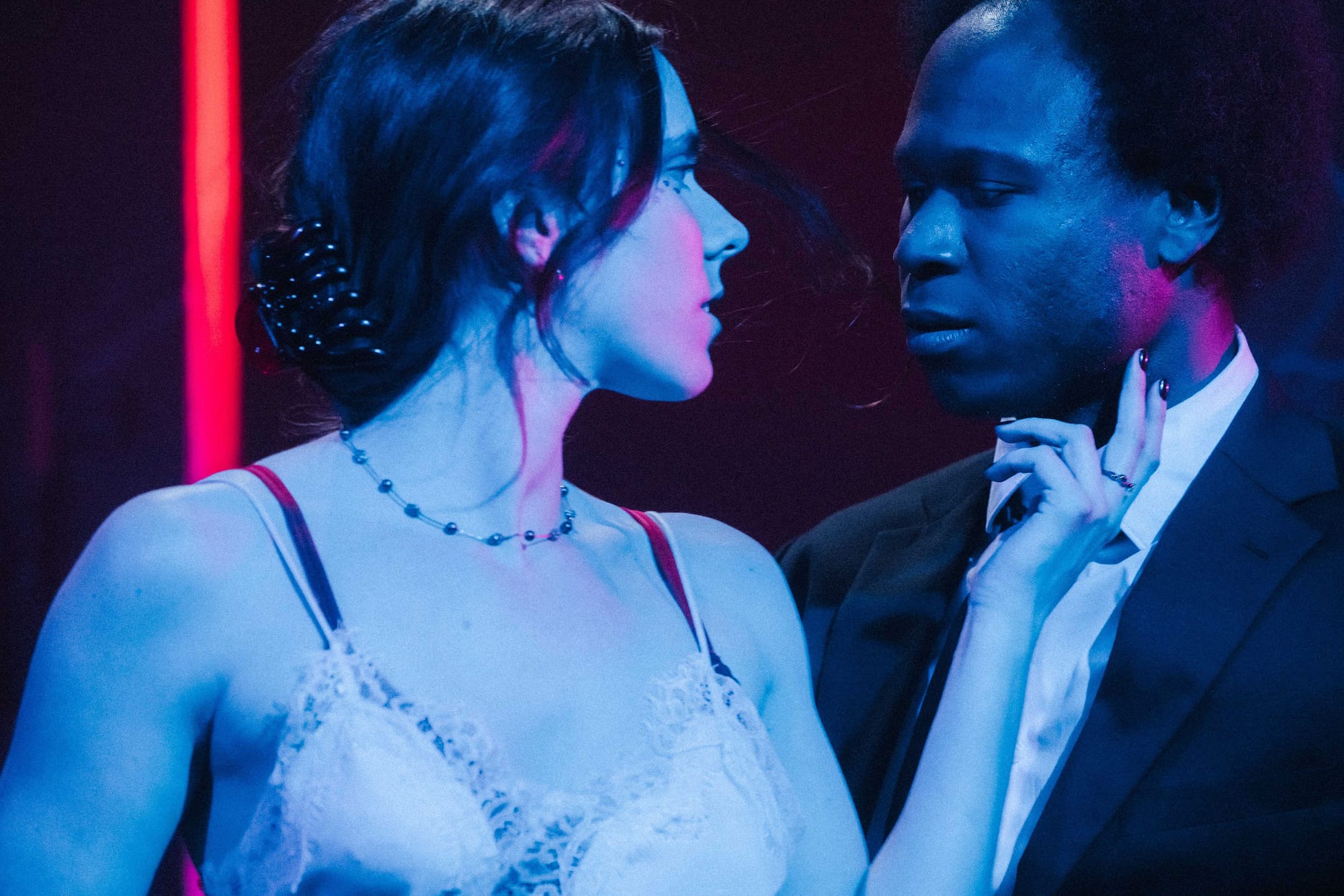
It closed last weekend, but I’m glad I caught Julie (Rating: ✭✭✭✭), Polly Stenham’s adaptation of Strindberg’s Miss Julie. Under director Jordan Laffrenier, this show by the exciting indie company Icarus Theatre received a bracing, electric production.
Strindberg’s 1888 play — seething with themes of class, sex and gender — is so universal it’s been adapted and updated dozens of times. In Toronto alone, we’ve seen Yael Farber’s Mies Julie, set in apartheid-era South Africa, Tara Beagan’s Miss Julie: Sheh’mah, set in the B.C. interior in 1929, with the two servant characters made Indigenous survivors of residential schools, and Stephen Sachs’ Miss Julie: Freedom Summer, set in Mississippi during the height of the civil rights movement.
UK writer Stenham’s adaptation is a little less specific about its setting; the title character, played with a dangerous edge by Emily Anne Corcoran, seems like a millennial party girl with questionable ideas about health and safety — she has her maid, Kristina (a poised Tara Sky), prepare a naturopath-approved remedy for her dog’s pregnancy.
But the general outlines of the narrative remain intact. On the night of her 33rd birthday and still smarting from her recent breakup with her fiancé, the inebriated and drugged-up Julie flirts with her wealthy father’s driver, Jean (Jamar Adams-Thompson), who’s engaged to Kristina.
The geological veins of colour in the blood-red painted backdrop of Laffrenier’s set and jagged stabs of sound in Jamal Jones’ score hint at Julie’s instability. I also appreciated some kitchen implements that screamed out “Chekhov’s knife rack.”
Corcoran delivers a completely convincing performance of an unhinged woman. The way she uses her privilege to upset the equilibrium in the household has an urgency that never lets up.
The other actors give fine support, suggesting the years they’ve been toiling at these jobs — all to have things precariously upended by their employer’s daughter. You know a play is working when just watching actors do certain things on a stage — sweep up broken glass, move wine bottles — is riveting.
I hope this production gets acknowledged come awards time.
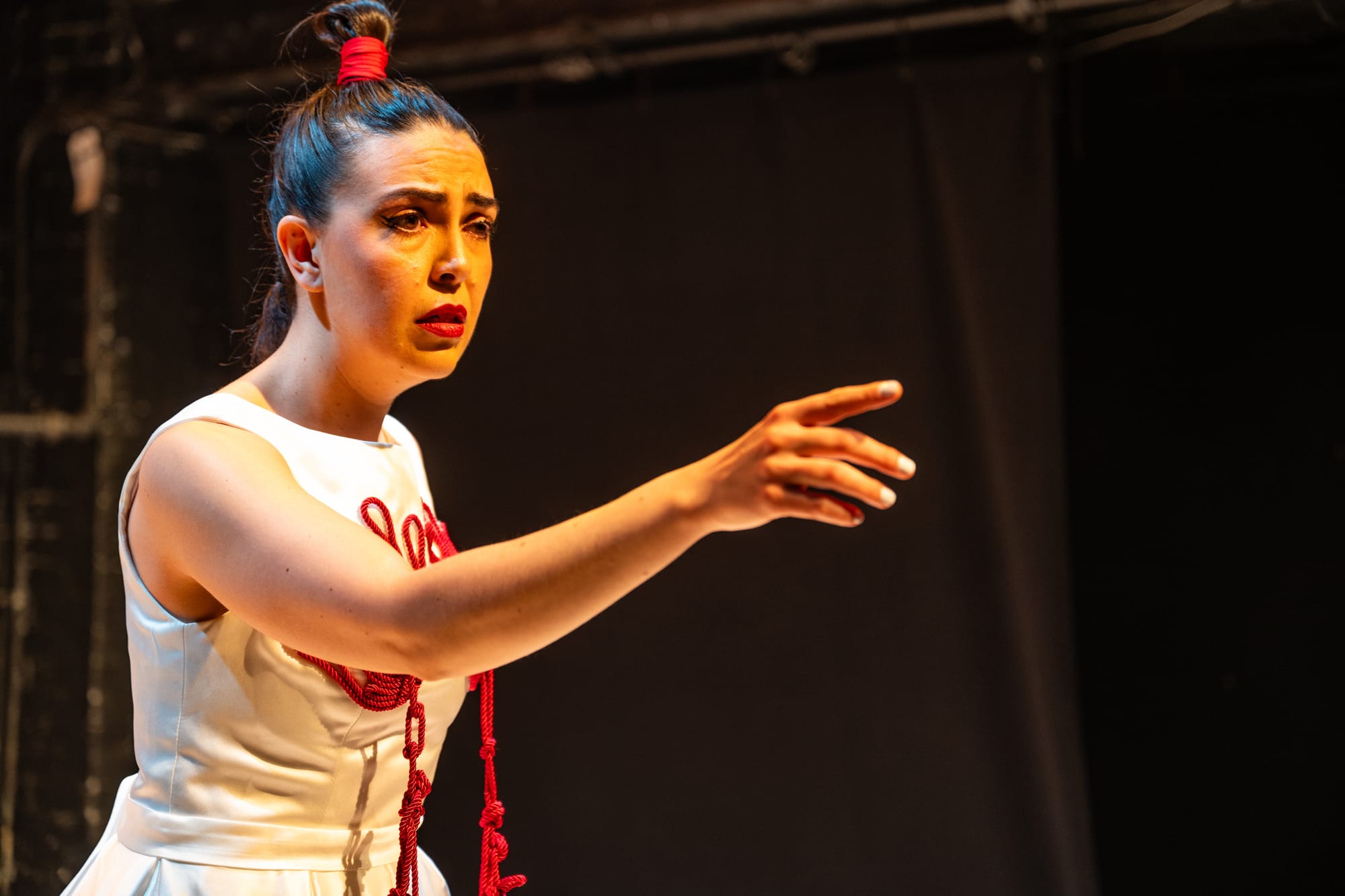
Speaking of unhinged women, Kill Your Father (Rating: ✭✭✭) is Brazilian Grace Passô’s audacious take on the Medea myth. It’s a very loose adaptation, more of a wailing jazz solo than a full piece, a riff on an idea rather than a straight retelling. For instance, this Medea never once names her unfaithful husband/oppressor, Jason. She won’t even dignify him with a mention. Clever.
“I need you to listen to me,” spits out the powerful performer Maria Paula Carreño at the top of the show, produced by Expandido Projects. She then proceeds to introduce various women in her unnamed neighbourhood where she’s been exiled. They all have tales of abandonment and abuse. “Are you listening to me?” she asks, repeatedly.
What follows is a striking but rather rambling and unfocused monologue about men’s oppression of women. At one point, we in the audience become her children (girls, not boys as in the traditional story), who hopefully will get to right the wrongs she and her global sisters have experienced through the ages.
Director Marcio Beauclair adds lots of intriguing touches to the play. Renato Baldin’s set is dominated by what appears to be a macramé hanging of an oversized vagina, its folds containing many surprises for Carreño to dig into to achieve her long overdue revenge.
Equally striking is his costume, an elegant off-white dress with bloody handprints literally hanging in shreds from the breast area.
There’s not enough in the script to provide a sense of narrative or momentum, but Carreño’s chilling, stylized performance and the no-fucks-given presentation — the opening images include indictments of the Epstein files and Gisèle Pelicot’s abusers — sizzle with suggestiveness.
Kill Your Fathers runs until Apr. 4 at Theatre Passe Muraille Backspace (16 Ryerson). Ticket details here